

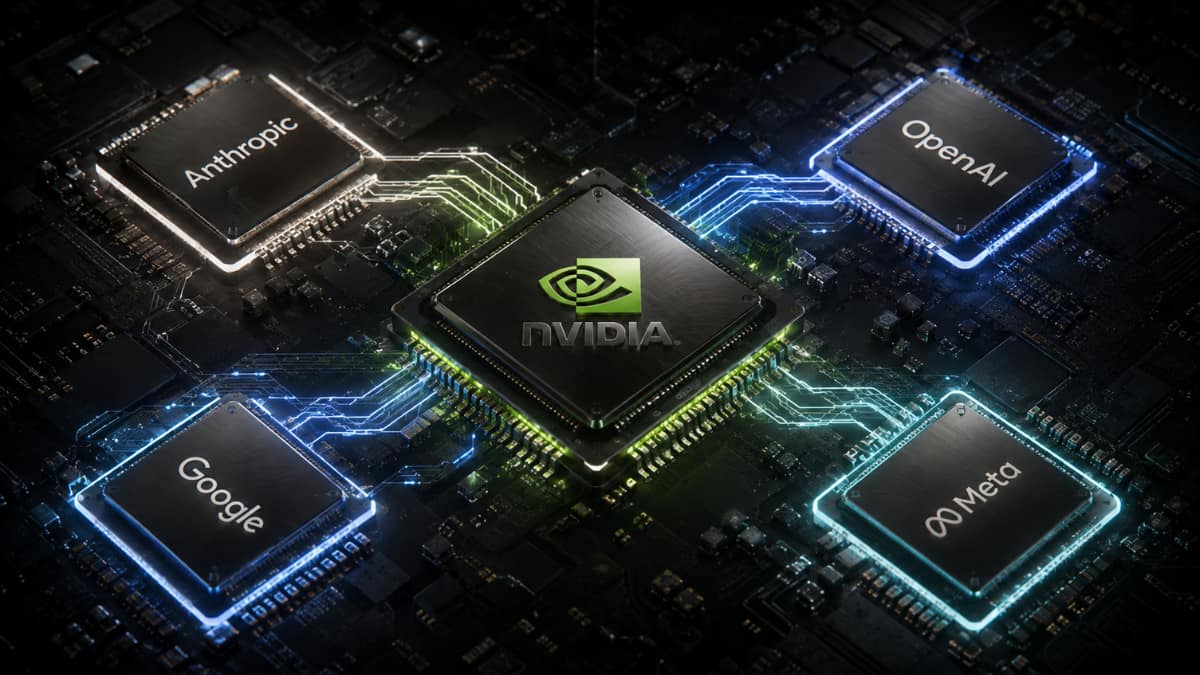

Anthropic confirmed this week it’s hiring a custom silicon team to design chips for running Claude. The announcement was quiet a job listing, a spokesperson confirmation, no big launch event. Easy to file under “interesting but expected” and move on.
But zoom out for a second.
OpenAI shipped its first custom inference chip in June. Google has been running models on its own TPUs for years. Meta has designed and deployed its own silicon. Mistral is reportedly exploring the same path. And now Anthropic.
Five of the most important AI labs in the world, all arriving at the same decision, within roughly the same window. None of them are copying each other. All of them looked at the same competitive landscape and reached the same conclusion independently.
That kind of convergence doesn’t happen by accident. It happens when an entire industry agrees that the thing everyone assumed was someone else’s problem is actually the problem and that whoever solves it first has an advantage that’s very hard to close later.
Table of Contents
The Problem With Depending on NVIDIA
NVIDIA makes extraordinary hardware. H100s and GB200s are genuinely the best tools available for training and running frontier models at scale, and the company has earned its dominance. But dominance is exactly the problem.
When your most critical infrastructure, the hardware your entire product runs on, is controlled by a single supplier, that supplier has enormous leverage over your costs, your capacity, and your timeline. In an environment where compute demand consistently outstrips supply, that leverage compounds. Labs have been competing not just on model quality but on who can secure enough GPU allocation to train and serve at scale. Paying premium prices to a supplier who knows you have no alternative is not a long-term competitive position.
Custom silicon changes that equation. It doesn’t eliminate NVIDIA from the picture, Anthropic explicitly said it will take a multi-chip approach, using outside hardware alongside its own designs. But having proprietary chips for specific workloads reduces dependency at the margins, and at the scale these companies operate, margins matter enormously.
Also Read: AI Was Supposed to Stop Cheating. Instead, 58,000 Students Must Retake Their Exams.
The Co-Design Advantage
Reducing NVIDIA dependence is the defensive reason to build custom silicon. The offensive reason is more interesting.
When a chip is designed for a specific model, and the model is designed with that chip in mind, the two can be optimized against each other in ways that general-purpose hardware never allows. OpenAI described this explicitly with Jalapeño, the architecture was built around the specific memory movement, networking, and serving patterns their models actually use, not the patterns a chip designed for the broader market has to accommodate.
Anthropic is pointing at the same logic. The plan isn’t to hand a silicon team a spec sheet and wait. It’s to have hardware and model teams working side by side, co-designing both simultaneously. That kind of tight feedback loop is how you squeeze performance out of a system that a lab buying off-the-shelf hardware simply cannot replicate, regardless of how much they spend.
The gap this creates compounds over time. A model running on hardware tuned specifically for it is faster and cheaper to serve than the same model on general hardware. Faster and cheaper to serve means lower costs per query, which means more competitive pricing, which means more users, which means more revenue to invest in the next generation of both the model and the chip.
Google figured this out years ago. The TPU program didn’t just save Google money, it gave Google a structural advantage in how efficiently it could scale. Every frontier lab now building custom silicon is trying to access that same flywheel.
Where Anthropic Is Starting and How Far Behind It Is
The honest part of this announcement is what it isn’t. Anthropic is hiring, not shipping. The silicon team doesn’t exist yet in any meaningful form. The Information reported earlier that Anthropic was in talks with Samsung as a potential manufacturing partner, but nothing has been confirmed beyond the job listings and a spokesperson saying the plans are real.
OpenAI’s Jalapeño took nine months from design to tape-out, which they described as the fastest ASIC development cycle ever achieved in high-performance semiconductors. Even at that pace, Anthropic is looking at years before custom silicon meaningfully changes how Claude runs in production.
In the meantime, the multi-chip approach Anthropic described is the practical reality. Custom designs for specific workloads, NVIDIA hardware for everything else, with the balance shifting gradually as the in-house team matures. That’s not a weakness, it’s the same path every lab on this list has walked. Google didn’t abandon third-party hardware overnight. Meta still uses a mix. OpenAI’s Jalapeño is inference-only; training still runs on NVIDIA.
The race isn’t to replace NVIDIA completely. It’s to reduce dependence enough that NVIDIA’s leverage stops being a strategic vulnerability. Anthropic just decided it’s ready to start running that race.
Also Read: Best Open Source AI Assistants You Can Run Locally
What This Looks Like in Two Years
By the time Anthropic’s silicon team ships anything real, the landscape it’s entering will look different from today’s. OpenAI will have moved past Jalapeño’s first generation. Google will have another TPU iteration in production. The labs that started earliest will have compounded their advantage further.
That’s the uncomfortable math underneath this announcement. Building custom silicon is the right move. It’s also a move that rewards starting early, and Anthropic is not starting early.
What matters now is whether the co-design approach, model teams and hardware teams building against each other from day one produces something faster than the traditional chip development timeline would suggest. That’s the bet Anthropic is making. Not that it can catch Google’s decade-long TPU head start, but that tight software-hardware co-design compresses the timeline enough to matter.
Five labs, same conclusion, different starting points. The next few years will show whether the convergence extends to the outcomes as well.