

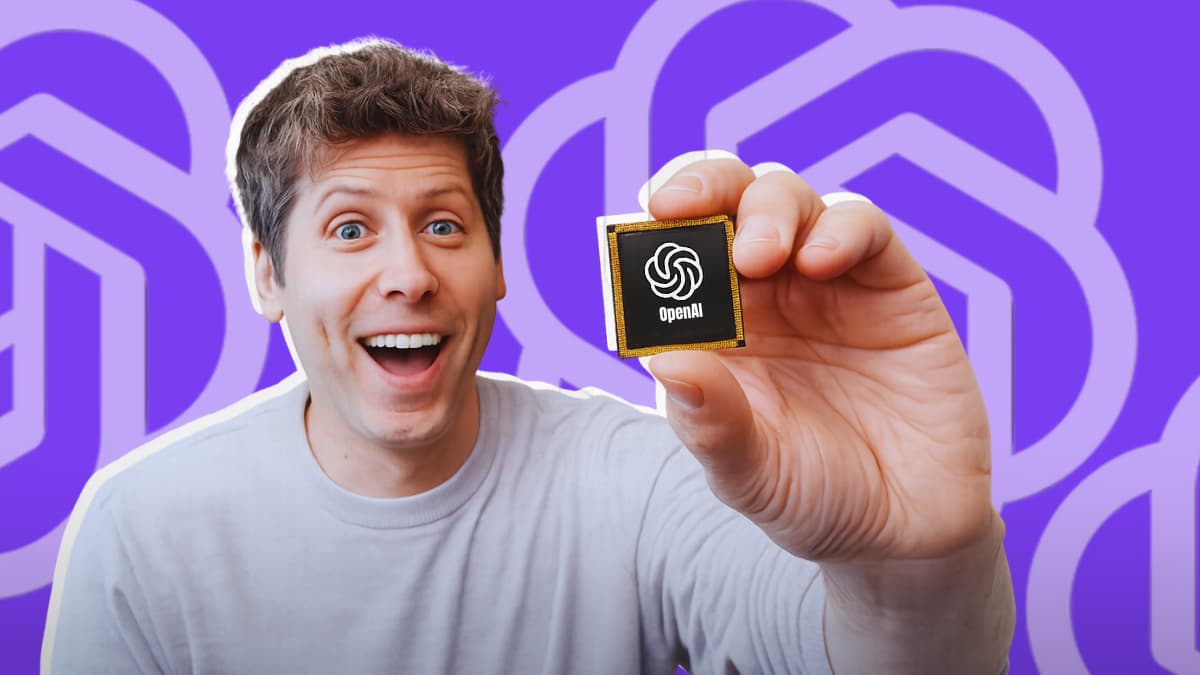

When the news broke that OpenAI had built a custom chip, the instinct was to frame it as a NVIDIA story. Another lab trying to cut the cord, reduce dependence on H100s, claw back some margin from the company that’s been printing money off the AI boom.
That’s not quite what’s happening here.
The chip is called Jalapeño, built with Broadcom, and it doesn’t touch training at all. It’s an inference chip, meaning it only runs models after they’re already built, when a user sends a message and ChatGPT has to respond. The compute-heavy work of actually training those models still runs on NVIDIA hardware. OpenAI isn’t replacing NVIDIA. It’s going after a different part of the problem entirely, the part that happens millions of times a day, every time someone uses one of their products.
That distinction matters because inference is where AI costs actually accumulate at scale. Training happens once per model. Inference never stops.
Why inference, not training
Training a frontier model is expensive, but it’s a one-time cost per run. Inference is the bill that arrives every single day, every hour, every query. At the scale OpenAI operates, ChatGPT alone handles hundreds of millions of users, even small improvements in how efficiently a chip processes each request translate into actual money and speed.
Jalapeño was designed specifically around that problem. The architecture reduces data movement between memory and compute, which is typically where inference chips waste the most energy and time. Early testing shows better performance-per-watt than current alternatives, though OpenAI says full benchmark numbers are coming in the next few months. The goal, as they describe it, is to combine the throughput of today’s leading accelerators with the low latency of specialized inference systems, something general-purpose chips weren’t built to optimize for simultaneously.
Greg Brockman framed it simply: they have deep knowledge of their own workloads, and they built something around exactly those workloads instead of adapting something designed for a broader market.
The part nobody is talking about: The chip helped design itself
Jalapeño went from blank slate to manufacturing tape-out in nine months. For context, complex custom silicon typically takes two to four years. OpenAI is calling it the fastest ASIC development cycle ever achieved in high-performance semiconductors, and the reason they can make that claim is sitting in the announcement almost as a footnote: OpenAI’s own models assisted in the design and optimization process.
The same models running on NVIDIA hardware today helped engineer the chip that will run them tomorrow. That loop is genuinely new. AI accelerating chip design isn’t unheard of Google has used ML for chip floorplanning, but using the production models themselves, the ones serving real users, to help build their own successor infrastructure, is a different kind of claim.
If it holds up as a repeatable approach, nine months becomes the baseline rather than the record. That has implications well beyond OpenAI.
What changes for users
Most of this is invisible until it isn’t. A faster inference chip doesn’t announce itself, it just means ChatGPT responds quicker, Codex finishes a task with less waiting, and the API gets cheaper to build on. The announcement specifically calls out real-time coding models as an early focus, which makes sense given how latency-sensitive agentic work is. An agent chaining twenty tool calls doesn’t just need a good answer, it needs each step to return fast enough that the whole task doesn’t bog down.
The deployment timeline is end of 2026, with the multi-generation platform expanding from there. So none of this changes what users experience today. But the math OpenAI is running is that every efficiency gain at the chip level compounds across everything above it.
This is bigger than a chip
OpenAI is not only developing frontier models or building products on top of them, it is designing the infrastructure underneath them. Chip architecture, kernels, memory systems, networking, scheduling, deployment systems, and product experience.
That’s the whole stack. Models at the top, chips at the bottom, everything in between owned and optimized toward the same goal.
Google got there from cloud infrastructure outward. Amazon built chips because it needed them for AWS. OpenAI is getting there from the model downward, starting with what the model needs and engineering backward to the silicon. It’s a different order of operations, and Jalapeño is the first visible piece of what that actually looks like in hardware.
NVIDIA isn’t threatened by a single inference chip from a lab that will still buy training hardware from them for years. But a vertically integrated OpenAI that controls its own inference economics is a different kind of company than the one that existed last year. That’s the actual story here.