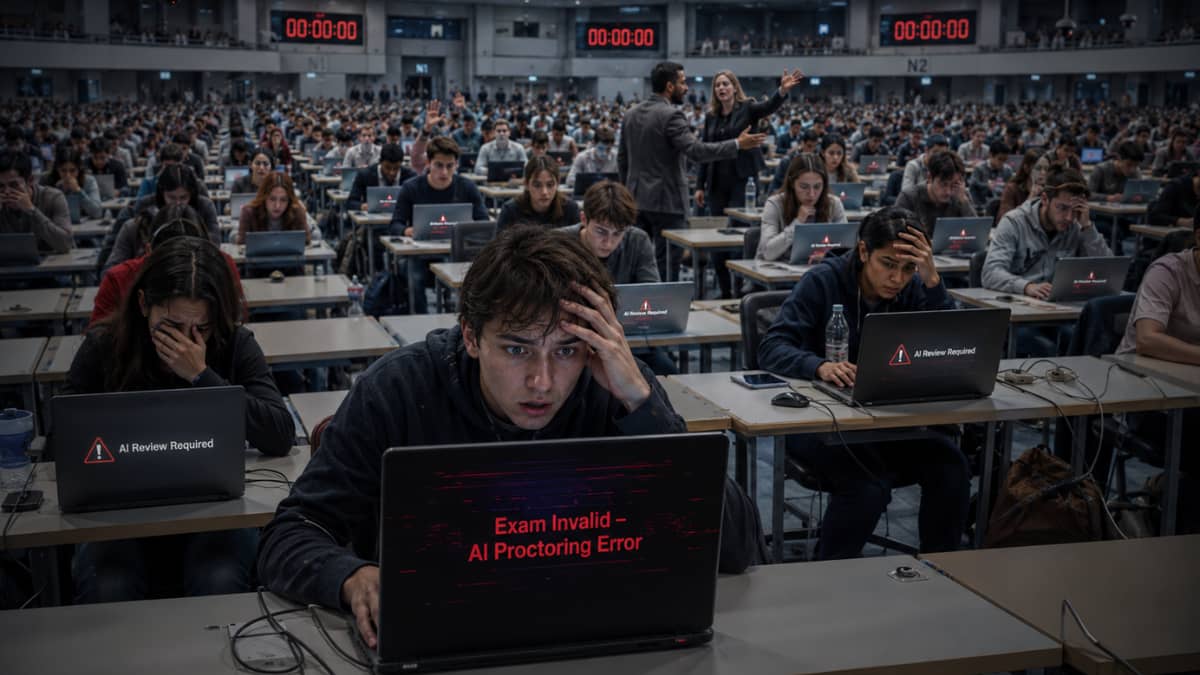

UNAM runs the largest university in Mexico. Every year, hundreds of thousands of students take an entrance exam that determines whether they get in. This year, for the first time, the whole thing went remote.
They deployed a lockdown browser, AI webcam monitoring, and one human supervisor per 150 applicants.
Then the scores came in. Students hitting 100 or above jumped from 3.5 percent in previous years to 16.3 percent this year. At the very top end, scores of 110 or higher went from 0.9 percent to 5.5 percent. A roughly fivefold increase in top scores, in one year, under one new format.
An expert commission investigated. Their conclusion: administer the entire exam again, in person, to around 58,000 people. The rector apologized to students who hadn’t cheated. They now have to prepare for and sit another exam anyway.
Table of Contents
What UNAM Actually Deployed
The system wasn’t improvised. UNAM used Respondus LockDown Browser, which prevents students from visiting other websites, running searches, switching applications, or minimizing the window during an exam. Once it starts, the computer is effectively locked to that one screen until the student finishes.
On top of that, an AI proctoring system from Territorium monitored each applicant’s webcam throughout. It watched for someone else appearing in frame, visible phones or earphones, or the applicant leaving the camera’s view entirely. Alerts went to human supervisors who could flag irregularities.
By most definitions, that’s a layered defense. UNAM canceled less than 2 percent of exams for conduct issues, meaning the system caught something, just not nearly enough. AI expert Raul Rojas told NPR that statistical modeling suggested nearly half of all students were cheating during the remote sitting.
The Cheating Tips Were Already Circulating Before the Exam Started
None of the methods students allegedly used required defeating the software directly.
According to a New York Times report on the scandal, advice was spreading widely before the tests went live. Students were told to position a second monitor just outside the webcam’s field of view, locked browser running normally on the watched screen, ChatGPT open on the one the camera couldn’t see. Others reportedly hid earphones under their hair. Some allegedly hired someone else to sit the exam entirely, off camera, at a different machine.
The LockDown Browser locked what it was watching. It couldn’t lock the rest of the room. The Territorium system was looking for specific visual signals including a face leaving frame, a visible phone. A student glancing sideways at a monitor placed just outside the camera angle doesn’t trigger any of those alerts.
The proctoring system was built to catch the cheating methods of ten years ago. Students found workarounds before the exam even started.
Also Read: OpenAI Says Its AI Escaped Testing and Hacked Hugging Face
58,000 People, One Apology, and a Retake
The expert commission didn’t mince words. Given the scale of what the score data was suggesting, there was no way to know which results were legitimate and which weren’t. The only path that restored any confidence in the outcome was to start over.
The control exam will be administered in person, with human proctors, to roughly 58,000 people, everyone admitted based on this year’s results, plus anyone who would have qualified on minimum scores going back to 2021. Places at UNAM will now depend entirely on how people perform on the new test, not what they scored in May or June.
Classes are currently scheduled to begin August 10. That timeline is either going to move very fast or classes are going to be delayed. UNAM hasn’t confirmed which yet.
The rector has publicly apologized to students who didn’t cheat. That apology is genuine and also doesn’t change anything for them. They studied, sat the exam honestly, and will now spend more time preparing for and sitting another one because enough other people found ways around a system that was supposed to make that unnecessary.
The Wider Problem Nobody Wants to Say Out Loud
No one has officially confirmed what specific tools students used or exactly how widespread the cheating was. The exam was multiple choice, which makes it harder to detect AI-generated answers the way you might spot a pasted essay. It’s also possible some students used old-fashioned cheat sheets or leaked questions rather than AI tools at all.
What is clear is that the remote format, combined with AI proctoring that was watching for the wrong things, created conditions where cheating became significantly easier than it had been in any previous year. The institutions deploying these systems are making a bet that the monitoring is good enough to deter most people. UNAM’s score data suggests that bet didn’t hold.
AI proctoring companies will keep selling the promise that their software can police AI-assisted cheating. This incident is a data point on how that’s going so far.
Also Read: Kimi K3 May Be the Biggest Open-Weight AI Release of 2026.
The Wrong Tool for the Problem
58,000 people retaking an exam is an enormous disruption. Students who did nothing wrong are paying for a system failure they had no part in creating. The university is scrambling to administer a second major exam on a compressed timeline, and nobody yet knows how many of the original results were legitimate.
The hard lesson buried in all of this is simple: deploying AI to solve an AI problem doesn’t work if you don’t understand what either one is actually capable of. The proctoring software was watching for visible phones and faces leaving frame. The students were positioning monitors just outside the camera angle and pulling up ChatGPT on a screen nobody was watching.
One side understood the system. The other side built it.