


Jensen Huang walked onto the GTC stage and said something that did not sound like a chip announcement. He called Vera Rubin “the greatest infrastructure buildout in history.” That is a bold claim even for NVIDIA.
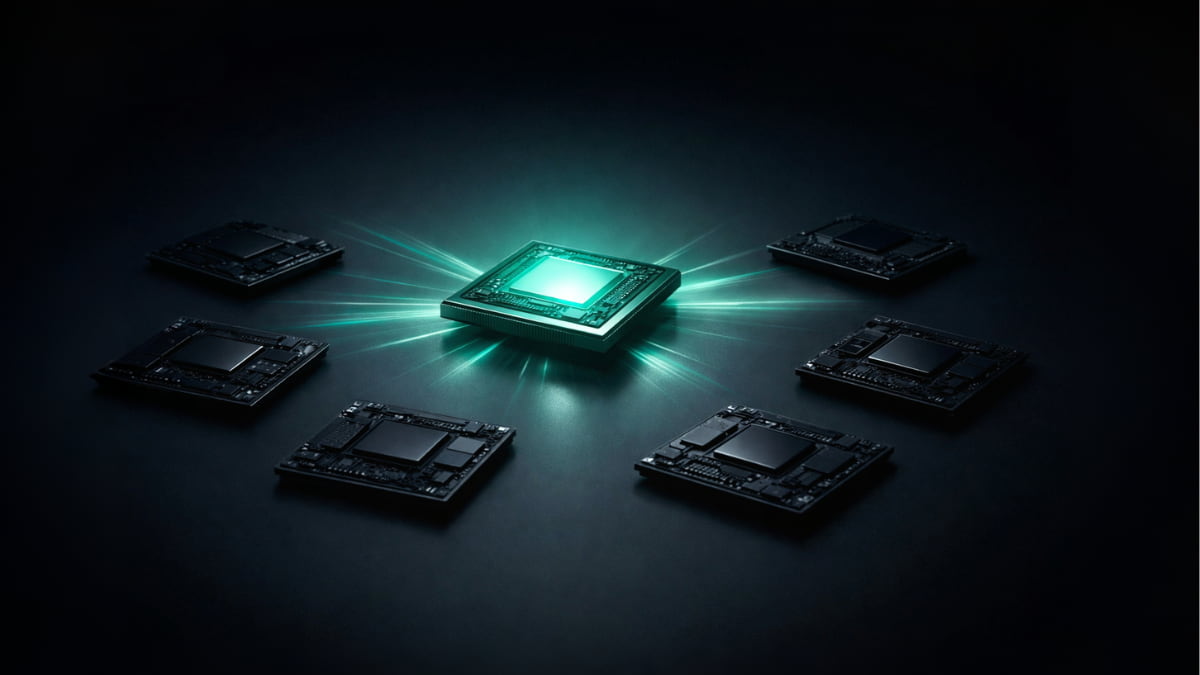
But when you look at what Vera Rubin actually is the ambition makes more sense. This is not a faster GPU. It is seven chips designed to work together as one supercomputer, built specifically for a world where AI does not just answer questions but plans, executes, and runs continuously without stopping.
Every GPU you have used until now was designed for training massive models or answering queries fast. Neither of those is the same as running an agent that plans, executes tools, checks its own work and keeps going for hours. Current infrastructure was simply never designed for that workload.
Vera Rubin is NVIDIA’s answer to that problem.
Table of contents
What is Vera Rubin
Vera Rubin is seven chips working as one system. A GPU, CPU, Groq LPU, networking chip, storage chip, DPU and an Ethernet switch, each handling a different phase of the AI workload so nothing becomes a bottleneck.
The GPU handles heavy model compute. The CPU handles agentic environments. The Groq LPU handles low latency inference. The storage rack handles the massive context memory agents need for long running tasks. The networking chips keep everything synchronized across the whole system.
These are enterprise and hyperscale deployments & AWS, Google Cloud, Microsoft Azure and Oracle are among the first to get access. But the models you use every day from Anthropic, OpenAI, Meta and Mistral will run on this infrastructure. That is where it becomes relevant to everyone.
The CPU rack is the real story
Everyone will talk about the Rubin GPU. The part worth paying attention to is the Vera CPU rack.
Reinforcement learning and agentic AI need enormous numbers of CPU based environments running continuously. Every time an AI agent takes an action, checks its output, adjusts its approach and tries again, that loop runs on CPU infrastructure, not GPU. Current data centers were never built with that workload in mind. GPUs trained the models. CPUs were an afterthought.
The Vera CPU rack changes that. 256 Vera CPUs in a single liquid cooled rack, delivering twice the efficiency and 50% faster performance than traditional CPUs. Built specifically to keep agent environments running continuously and synchronized across the entire AI factory.
Mistral’s CTO said it directly, STX is “purpose built for AI agents memory” ensuring models can “maintain coherence and speed when reasoning across massive datasets.”
That is the workload your current infrastructure struggles with. An agent that runs for hours, maintains context across thousands of tool calls, and never loses track of what it was doing. Vera CPU was designed for exactly that.
Related: Nvidia Is Building NemoClaw, an Open Source AI Agent Platform That Runs on Any Chip
The Groq 3 LPU changes the inference game
If the Vera CPU keeps agents running, the Groq 3 LPU is what makes them respond fast.
Groq’s LPU architecture was always built around one thing, deterministic low latency inference. No memory bandwidth bottlenecks, no unpredictable response times. Just fast consistent output every single time. That matters for agents that need to make decisions quickly and keep moving.
The numbers from the official announcement are striking. 35x higher inference throughput per megawatt compared to alternatives. 256 LPU processors per rack with 128GB of on-chip SRAM and 640 terabytes per second of scale-up bandwidth.
The use case it unlocks is genuinely new. Trillion parameter models running with million token context windows at low latency. Until now you had to choose — run a massive capable model slowly or run a smaller faster model with less capability. Vera Rubin with Groq 3 LPU removes that tradeoff for organizations with the infrastructure to deploy it.
For the models that run on top of this the implication is clear. Longer context, faster responses, more capable agents that do not slow down under heavy workloads.
Who is building on it
The list of organizations confirmed to use Vera Rubin is not a surprise but it is worth noting.
Anthropic, OpenAI, Meta and Mistral are all looking to deploy on Vera Rubin for training larger models and serving long context multimodal systems. AWS, Google Cloud, Microsoft Azure and Oracle are among the first cloud providers getting access.
When the four most important AI labs in the world are all building on the same infrastructure platform that tells you something about where the industry is heading.
Why this matters even if you never touch it
Vera Rubin is enterprise infrastructure. The price point, the scale, the deployment complexity — none of that is aimed at individual developers or small teams.
But the models you use every day are built and served on infrastructure exactly like this. Every time Anthropic ships a smarter Claude, every time OpenAI improves GPT-5 or Mistral releases a more capable open source model, the training and inference running behind that happens on platforms like Vera Rubin.
Better infrastructure means better models at lower cost. Lower cost may result in more accessible APIs
The agentic AI wave everyone is writing about needs hardware that can actually support it. Agents that run for hours, maintain million token context, execute thousands of tool calls without slowing down, that requires purpose built infrastructure. Vera Rubin is that infrastructure.