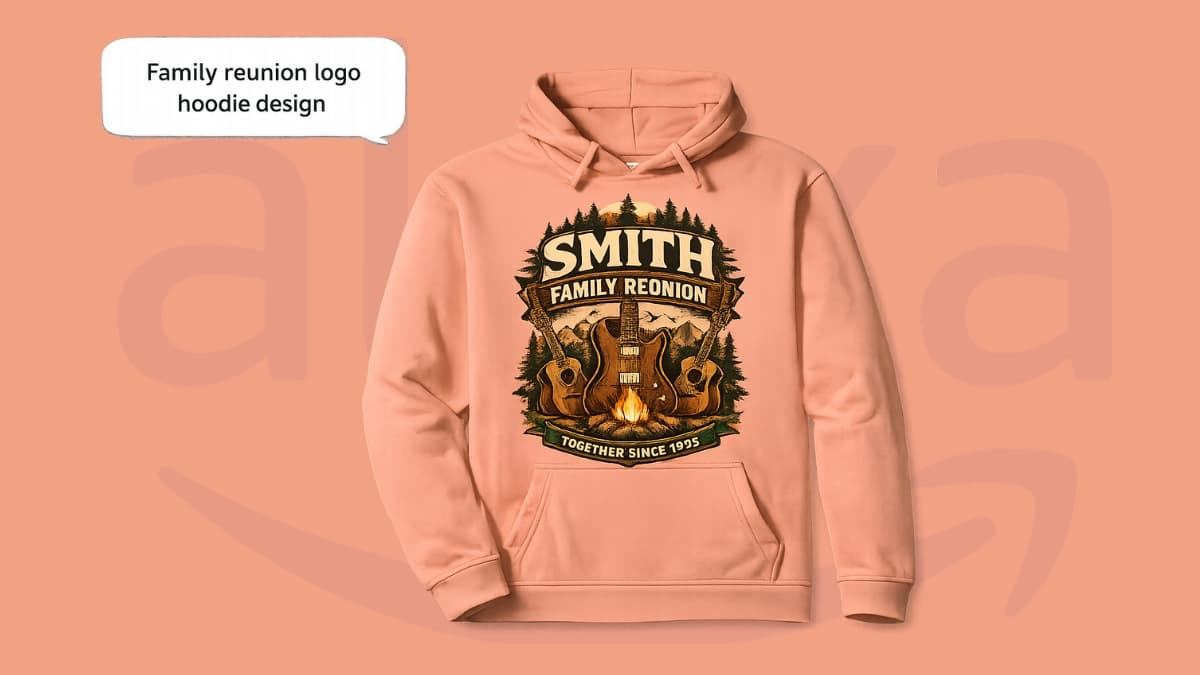

Amazon didn’t hold a press event for this. Just a quiet update to the Shopping app, tap the Alexa icon, describe what you want on a T-shirt, watch it appear. Add to cart. Prime shipping handles the rest.
That’s it. That’s the whole barrier now.
For years, turning an idea into a physical product meant either learning design tools, hiring someone who had, or finding a platform that made it slightly less painful. Print-on-demand services like Redbubble and Fourthwall built businesses around that problem.
Amazon just solved that problem too.
Table of Contents
What the feature actually does
The feature lives inside Amazon’s Shopping app behind the Alexa icon. You describe your idea, the AI generates a design, you edit it through suggested actions or by typing changes, and the result goes straight to a product listing. T-shirts, hoodies, tumblers, water bottles, 13 product types total. Production and delivery run through Merch on Demand with Prime shipping.
It’s free to use. You pay for the product, nothing else.
The use cases Amazon suggests are, family reunion shirts, personalized gifts, a portrait of your dog on a tumbler. That framing is smart. It positions this as a convenience feature rather than a platform play. But convenience features at Amazon scale have a way of becoming something bigger than they first appear.
The platforms that should be paying attention
Redbubble, Fourthwall, Spring and other similar platforms didn’t only build merch tools. They built creator economies. Redbubble has independent artists uploading designs and earning royalties. Fourthwall is where YouTubers and streamers sell to their audiences. Spring, formerly Teespring, has been doing print-on-demand for over a decade.
What all of them share is a value proposition that just got harder to defend. They lowered the barrier to custom merch for people who couldn’t design. That was the product. Amazon made the problem they were solving disappear inside an app that 180 million Prime members already open to buy everything else.
The creator platforms have one thing Amazon doesn’t, community, audience connection, the reason a fan buys a streamer’s hoodie instead of a generic one. But for the casual end of the market, the family reunion shirts and one-off gifts, Amazon just made every alternative feel like extra steps.
You May Like: Google Built Gemma 4 12B Without Multimodal Encoders
The artist problem nobody wants to talk about
Amazon’s AI merch feature generates designs through Alexa. Those designs come from a model trained on something. Amazon hasn’t said what. That’s the part that should make you pause before you tap the Alexa icon and generate a watercolor portrait of your dog in the style of every watercolor artist whose work existed on the internet before a training cutoff.
This isn’t a new argument. The whole generative image debate has been running for three years now. But Amazon doing it at Prime scale is different from a startup doing it at startup scale. When the output ships on a hoodie to 180 million potential customers through the world’s largest retailer, the question of what the model was trained on stops being theoretical.
Amazon hasn’t addressed this. The announcement focused on use cases and supported product types. The artist community that’s been watching AI image generators carefully for the last few years will notice the silence.
None of this makes the feature illegal. It probably isn’t. But “probably not illegal” and “this is fine” are not the same thing, and a company the size of Amazon has enough resources to have thought harder about this than a two-sentence disclaimer burying the concern in a press release.
The barrier is gone. The question is what was holding it up.
Print-on-demand platforms aren’t dead. The creator economy Fourthwall and Redbubble built has actual social infrastructure behind it including audiences, communities, the specific reason someone buys merch from a creator they follow rather than generating their own version.
But the casual end of that market, the one-off gifts, the family event shirts, the “I had an idea for a design once” crowd, Amazon just absorbed all of that into a shopping app update.
The platforms that should be worried aren’t the ones with strong creator communities. They’re the ones whose main value proposition was just “we made this easier than it used to be.” Amazon made it easier than all of them, and it didn’t even need a separate app to do it.