
back to top
HomeTechChatGPT Wants Access to Your Bank Account

ChatGPT Wants Access to Your Bank Account

- Advertisement -

OpenAI did this with your health data in January. Now it wants your financial data too.

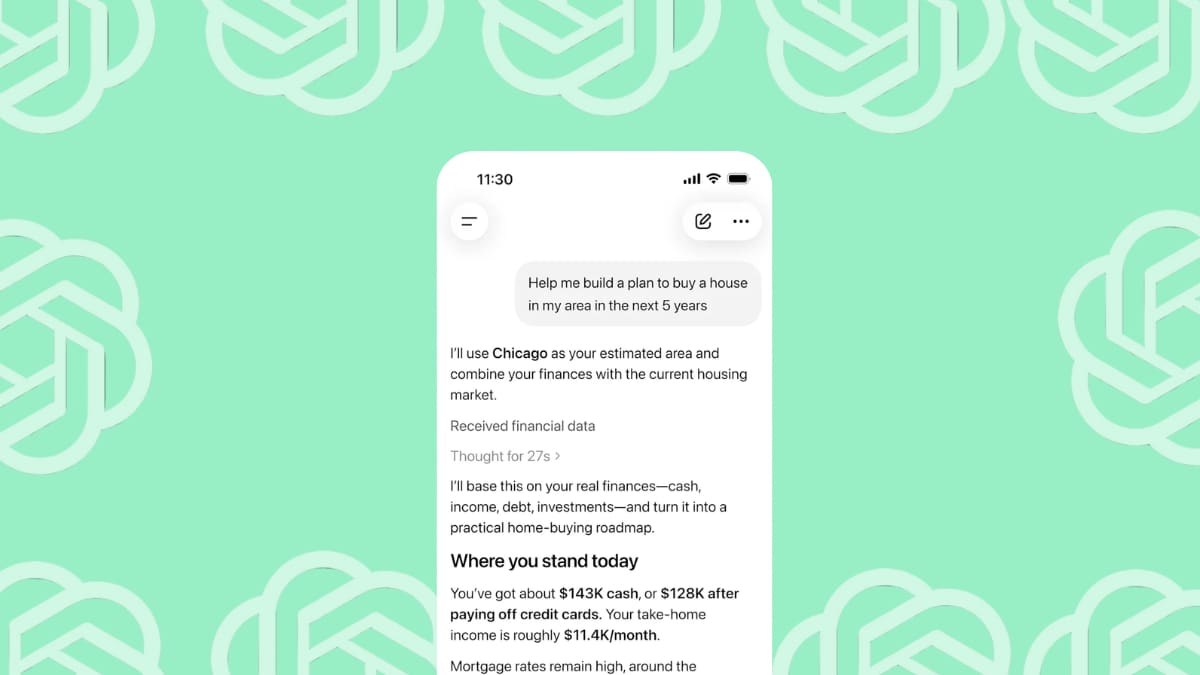
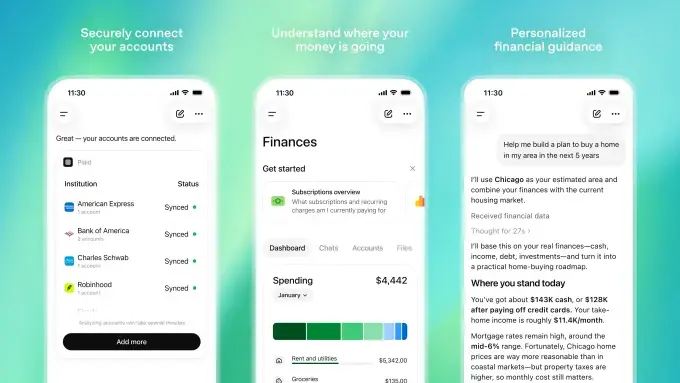
The company announced today that ChatGPT users can connect their bank accounts through Plaid, the financial bridging platform used by 12,000 institutions including Chase, Fidelity, Capital One, and Schwab. Once connected, ChatGPT gets a full view of your balances, transaction history, active subscriptions, investment portfolio, and liabilities like mortgages and credit card debt. In return you get a spending dashboard, personalized financial advice, and a chatbot that can flag unusual changes in your habits.

It’s launching in preview for Pro subscribers at $200 a month. OpenAI says Plus and eventually everyone else comes later.

What it can do and what it can’t
via OpenAI

OpenAI is careful about framing the boundaries. ChatGPT cannot make changes to your accounts or see full account numbers. Users can disconnect at any time, delete saved financial memories, and opt out of having their data used for model training.

What it can see is everything else. Your balance. Every transaction. Your stock portfolio. What you owe. And once connected, OpenAI has up to 30 days to delete your data after you disconnect which means pulling the plug isn’t quite as clean as it sounds.

The training opt-in is worth reading carefully too. The default isn’t entirely clear, and “Improve the model for everyone” as the label for sharing your financial data with OpenAI’s training pipeline is doing a lot of friendly framing around a significant decision.

You May Like: OpenAI Wanted Distribution on the iPhone. Apple Had Other Plans.

The pattern

In January OpenAI launched ChatGPT Health, a feature that let users connect medical records for health-related questions. The company was careful to note it wasn’t intended for diagnosis or treatment. The privacy questions that followed, what does OpenAI actually do with this data, how is it protected, what happens if there’s a breach were never fully answered.

Now the same playbook, with your bank account. OpenAI says users have control over their data. What the company doesn’t specify is what OpenAI itself does with that financial information beyond AI training, or whether any additional protections exist against a system breach. That’s the part people are going to keep asking about.

What happens to all this data later

OpenAI is a company that, by its own admission, eventually needs to turn a profit. It now has the potential to build a detailed financial profile of millions of users, spending habits, debt levels, investment behavior, subscription patterns, income signals buried in transaction history.

That’s an extraordinarily valuable dataset. The announcement doesn’t address what guardrails exist around it commercially, what happens to that data if OpenAI’s business model shifts, or what protections survive a potential acquisition or restructuring down the line.

Connecting your bank account to ChatGPT might be genuinely useful. The spending dashboard is a real feature. The financial advice could be good. But OpenAI has now collected your health data and your financial data without clearly answering what a company under commercial pressure does with either of them long term.

Don’t miss any Tech Story

Subscribe To Firethering NewsLetter

You Can Unsubscribe Anytime! Read more in our privacy policy

LEAVE A REPLY

Please enter your comment!
Please enter your name here

YOU MAY ALSO LIKE
Claude Will Soon Leave a Hidden Mark on Everything It Writes

Claude Will Soon Leave a Hidden Mark on Everything It Writes

0
Anthropic is adding invisible watermarks to text generated by Claude, and unlike a visible label, the marking is designed to travel with the text when users copy and paste it elsewhere. The move comes as AI-generated content becomes harder to distinguish from human writing and as the European Union begins requiring AI companies to make generated or manipulated content machine identifiable. Anthropic says the marking happens at the model level, meaning it can follow Claude-generated text across different products and surfaces rather than being tied to a particular app. The company also says it may survive some editing. But it raises a question, can AI-generated text actually be made traceable once it leaves the model that created it? And Anthropic's approach suggests the answer may be more complicated than simply adding a hidden signature to every sentence.
Zuckerberg Wrote 14 Pages About Open AI. His Best AI Model Is Still Closed

Zuckerberg Wrote 14 Pages About Open AI. His Best AI Model Is Still Closed.

0
Mark Zuckerberg published a 14-page essay today about why open-source AI is the path forward for humanity. Distribute intelligence rather than centralize it. Put the power in everyone's hands. A new era of personal empowerment. On the same day, Meta released Muse Glimmer, an open-source version of its most powerful model, Muse Spark, that anyone can download, modify, and build on for free. But the interesting part is, Muse Spark itself stays closed. You still pay to access it. The open version is nearly identical, Meta says, but the model that actually competes at the frontier, the one Zuckerberg's essay is implicitly defending remains behind a paywall. That gap between the philosophy and the product decision is what makes today's announcement interesting.

The Biggest AI Companies Are All Building Their Own Chips. That’s Not a Coincidence.

0
Anthropic confirmed this week it's hiring a custom silicon team to design chips for running Claude. The announcement was quiet a job listing, a spokesperson confirmation, no big launch event. Easy to file under "interesting but expected" and move on. But zoom out for a second. OpenAI shipped its first custom inference chip in June. Google has been running models on its own TPUs for years. Meta has designed and deployed its own silicon. Mistral is reportedly exploring the same path. And now Anthropic. Five of the most important AI labs in the world, all arriving at the same decision, within roughly the same window. None of them are copying each other. All of them looked at the same competitive landscape and reached the same conclusion independently. That kind of convergence doesn't happen by accident. It happens when an entire industry agrees that the thing everyone assumed was someone else's problem is actually the problem and that whoever solves it first has an advantage that's very hard to close later.