

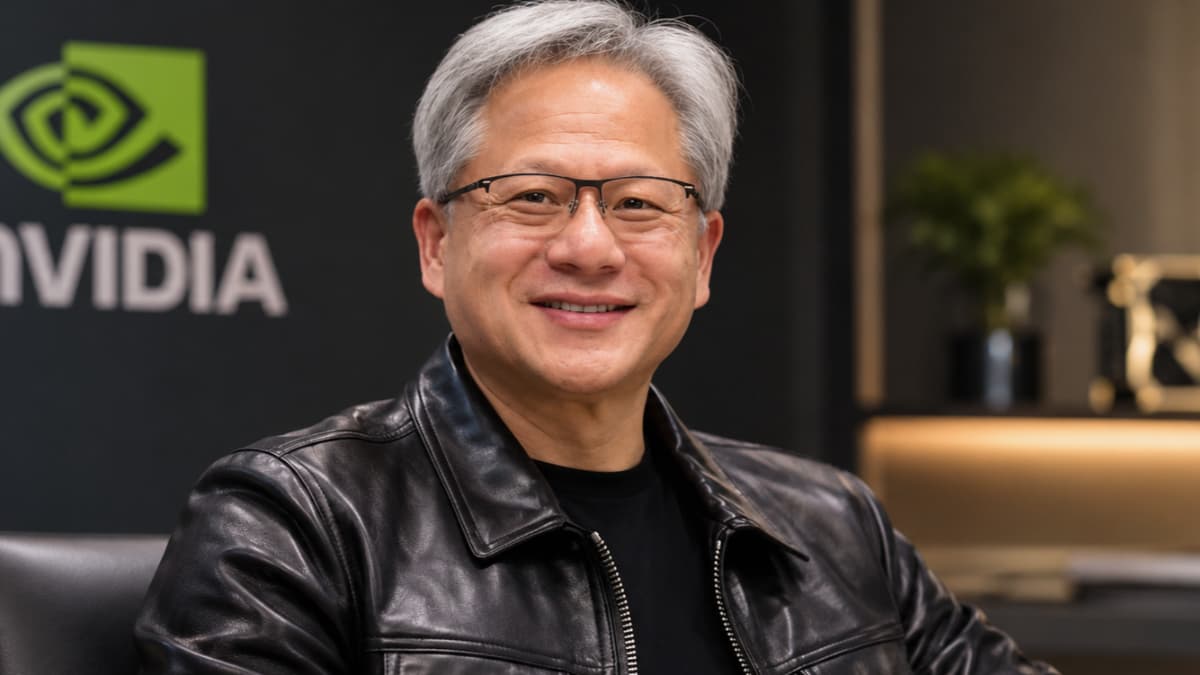

Jensen Huang, the co-founder who transformed Nvidia into the world’s most valuable chipmaker and the linchpin of the artificial intelligence boom, has resigned as chief executive after 33 years at the helm.
His departure comes amid a widening controversy over his reported personal relationships, including one with a businesswoman suspected by US intelligence agencies of having links to Chinese espionage, and an independent board investigation into potential national security risks.
Table of Contents
Colette Kress takes over as interim CEO as Nvidia begins succession search
Nvidia has appointed Colette Kress, its long-serving chief financial officer, as interim chief executive following Huang’s immediate departure. Kress, who joined the company in September 2013, will retain her CFO responsibilities while leading the company until a permanent successor is appointed.
The board said it would consider both internal and external candidates for the position. It has also appointed Harvey C. Jones as Nvidia’s first-ever board chair. Jones, a technology executive and venture investor, previously served as CEO and executive chairman of Synopsys.
In its announcement, the board expressed confidence in Kress’s ability to maintain the company’s direction, pointing to her experience overseeing Nvidia’s finances, operations and growth.
Kress said the company would continue advancing its work in accelerated computing and AI, with its focus remaining on customers, partners, developers and shareholders.
What led to Jensen Huang’s departure?
Huang’s resignation follows growing scrutiny over his reported relationship with Alice Huang (no relation), a Chinese businesswoman whose alleged links to Chinese intelligence have raised concerns within the US government.
The New York Times first reported that US intelligence agencies had concluded Alice Huang was recruited by China’s Ministry of State Security (MSS). The Financial Times subsequently corroborated the intelligence assessment, adding to concerns about the potential implications of her relationship with Nvidia’s chief executive.
The scrutiny also extends to Nvidia’s business. The Wall Street Journal reported that Alice Huang and her husband, Kang Wei, had leveraged their connection to Jensen Huang to secure access to Nvidia chips through their Singapore-based company, Megaspeed. Investigators have been examining whether restricted AI chips were subsequently diverted to China.
For US officials, the potential implications go beyond chip shipments. Huang’s position at the centre of the global semiconductor industry gives him access to commercially sensitive information, while his influence in discussions around US technology policy raises additional questions about possible exposure of sensitive deliberations.
However, an intelligence assessment that someone has links to a foreign government is not, by itself, proof that corporate secrets or government information were transferred. Whether any confidential Nvidia information was actually disclosed, and what investigators ultimately established, remain crucial questions.
Why Huang’s departure matters
Jensen Huang’s influence on Nvidia goes well beyond running the company. Over 33 years, he helped turn a graphics chipmaker founded in 1993 into the central supplier of computing infrastructure powering the artificial intelligence industry.
One of his most consequential decisions was Nvidia’s investment in CUDA, its software platform that allows developers to use GPUs for general-purpose computing. What began as a way to make graphics processors useful beyond gaming eventually became a foundation for modern AI development.
That investment gave Nvidia something its competitors could not easily replicate: an ecosystem of hardware, software, developer tools and infrastructure that made its GPUs deeply embedded in AI research and commercial applications.
Today, Nvidia’s influence extends across cloud computing companies, AI laboratories and major technology businesses building increasingly large AI systems. Its chips power the training and deployment of models, making the company a critical part of the global AI supply chain.
Huang’s departure therefore raises a question, how much of Nvidia’s competitive advantage is embedded in its technology and how much has depended on the person who built its strategy and relationships?
Also Read: Google’s New AI Policy Leaves Schools Choosing Between AI and Search
What happens to Nvidia now?
The leadership change comes at a time when Nvidia’s position in the AI industry is being shaped by two competing forces: the strength of its existing ecosystem and the growing desire among customers to have alternatives.
CUDA is a major part of that equation. Developers have spent years building AI applications and workflows around Nvidia’s software platform. Moving to another chipmaker is therefore not as simple as buying a different processor. Companies may also have to adapt software, optimise workloads and rethink parts of their infrastructure.
But that advantage does not mean Nvidia can take its customers for granted.
Major cloud providers and technology companies have been investing in alternatives, including their own custom-designed AI chips. Google’s TPUs and Amazon’s Trainium, for instance, give those companies more control over the hardware powering their AI services. AMD is also competing for a larger share of the accelerator market.
This creates an interesting tension for Nvidia. Its customers need enormous amounts of computing power, but some of those same customers have strong incentives to reduce their dependence on a single supplier.
Huang’s departure adds another dimension to that relationship. His industry connections and ability to articulate Nvidia’s strategy have been important parts of its rise. The company will now have to demonstrate that its technology roadmap, partnerships and execution can maintain their direction without his personal leadership.
The real test, then, is not whether Nvidia can continue selling GPUs after Huang. It is whether it can preserve the ecosystem and customer relationships that made those GPUs so difficult to replace in the first place.
Can Nvidia remain bigger than its founder?
For more than three decades, Jensen Huang was not just the person running Nvidia. He was the face of its transformation from a graphics chipmaker into one of the most influential companies in the technology industry.
His departure creates a test that Nvidia has never faced at this scale: whether the company can sustain its position without the person so closely associated with its strategy, culture and rise.
There are reasons to believe its foundations can withstand the transition. Nvidia’s software ecosystem, developer relationships, chip architecture and partnerships with major technology companies were built over decades. They do not disappear when one executive leaves.
But maintaining that advantage will require more than continuing to release powerful GPUs. Nvidia must retain customer confidence, keep developers invested in its platform and stay ahead of competitors looking to reduce their dependence on its hardware.
Ultimately, Huang’s departure may reveal something important about Nvidia’s evolution. The company has grown far beyond the founder-led business it once was. Its next chapter will depend on whether the organisation he built can continue delivering at the same scale without him.
The real measure of Huang’s legacy may not be how far he took Nvidia, but whether the company can keep moving forward without him.