
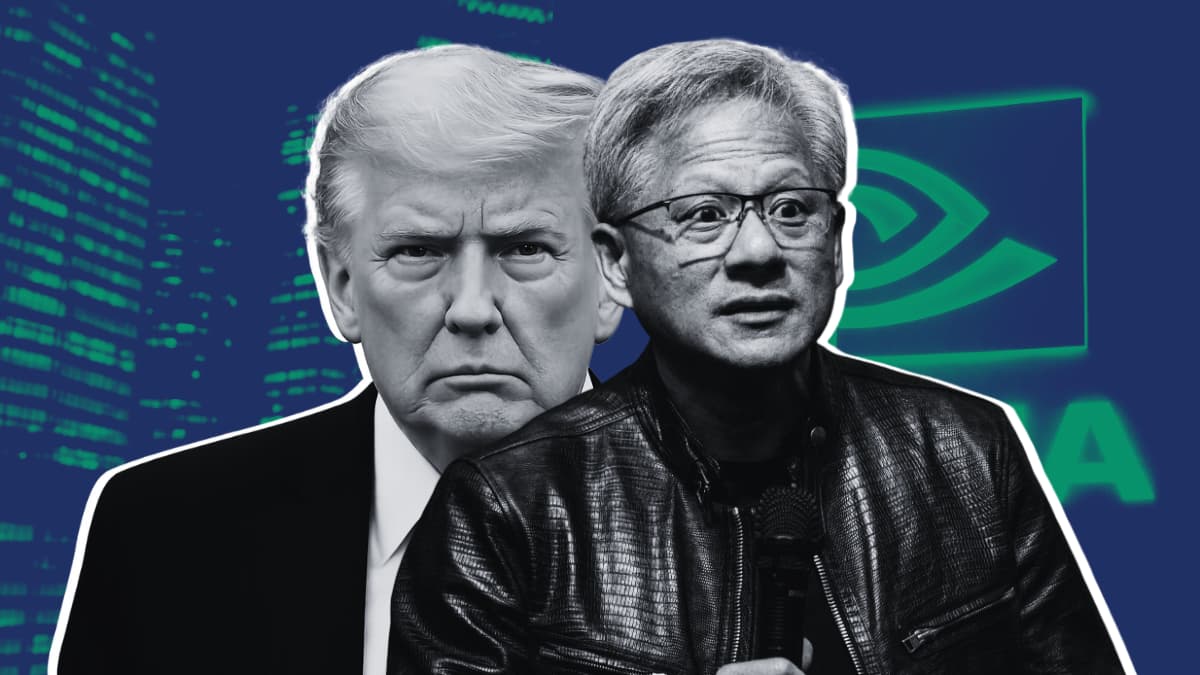

Earlier this year Jensen Huang wrote a big check. Five hundred billion dollars committed to US data centers, announced with the kind of fanfare that makes a president happy and keeps tariff threats at bay. Trump called Huang brilliant. Export controls on some Nvidia chips got walked back. At the time, it looked like everyone got what they wanted.
Then Huang flew to Taiwan, broke ground on a new Nvidia headquarters, and according to Reuters, announced the company would be spending $150 billion a year there. He called Taiwan the epicenter of the AI revolution. He said it’s where the chips come from, where the packaging happens, where AI supercomputers get built. He said Nvidia would be worth even more in three to five years because of it.
Nobody in the Trump administration has commented on that yet. Nvidia didn’t respond to questions about the tension between the two announcements. But the tension is there whether anyone acknowledges it or not, and it tells you something about where AI infrastructure actually lives versus where politicians want it to live.
Why Taiwan and not the US
Huang isn’t betting on Taiwan out of sentiment, though he was born there before emigrating to the US at nine. He’s betting on Taiwan because the manufacturing ecosystem the AI industry depends on is there and won’t be anywhere else for a long time.
The specific constraint is packaging. Advanced chip packaging, the process that stacks and connects chips into the dense configurations modern AI accelerators require, isn’t available at TSMC’s US factories yet. It exists in Taiwan. Nvidia’s next major AI system, Vera Rubin, which Huang described as a generational leap that will kick off the greatest infrastructure buildout in history, is going to face supply chain constraints throughout its entire lifespan. The Taiwan headquarters is partly a hedge against that.
There’s also the broader ecosystem. Foxconn, Wistron, Quanta Computer, all within reach of a Taiwan base. These are the companies that actually assemble AI servers at scale. Tech giants are collectively planning to spend $750 billion on AI infrastructure this year and a significant chunk of that flows through exactly this network. Huang isn’t building a headquarters in Taiwan because he wants to make a statement. He’s building it because the alternative is watching supply chain constraints choke Nvidia’s ability to meet demand that is, by his own description, accelerating at extraordinary speed.
The US manufacturing push is actual but it’s running years behind where the industry needs to be right now. Huang said it plainly four years ago when Nvidia started producing chips on US soil for the first time. He framed it as helping meet demand and strengthening the supply chain. What he didn’t say then, and what the Taiwan announcement makes clear now, is that US production is a supplement. Taiwan is still the foundation.
You May Like: Anthropic Says Mythos Isn’t Public Yet. ‘Mythos 1’ Keeps Appearing Anyway
The China problem Huang can’t solve from Washington
Trump’s export controls were supposed to keep advanced Nvidia chips out of China’s hands and pressure Beijing into dependence on US technology. The outcome has been almost the opposite. China stopped buying the chips entirely because of a requirement that chips subjected to Trump’s fee get routed through the US first. Beijing decided it would rather go without than risk the US tampering with hardware in its markets.
Nvidia has largely conceded China to Huawei. Huang said it himself to a US think tank, that Trump’s export curbs have “already largely backfired” and that conceding a market the size of China “probably don’t make a lot of strategic sense.” That’s a carefully worded sentence from someone who still needs to stay on good terms with the White House, but the meaning is clear enough.
The summit where Trump took Huang to meet Xi Jinping produced nothing on chips. Trump confirmed afterward that China has no plans to buy Nvidia’s products because they want to develop their own, and already have something they claim is more advanced than the H200. Whether that’s true is a separate question. What’s not separate is that Nvidia has lost meaningful access to one of the largest AI markets in the world because of a policy Huang disagrees with but can’t publicly oppose.
So Huang is navigating a situation where the US market wants domestic production he can’t fully deliver, the China market is effectively closed by policies he thinks are counterproductive, and the manufacturing ecosystem he actually depends on is in Taiwan, a territory the US president has sent genuinely confusing signals about protecting.
You May Like: Microsoft and Uber Are Running Into an AI Cost Problem
How long this tightrope holds
Huang has been remarkably good at keeping Trump satisfied without actually changing where Nvidia operates. The $1 million Mar-a-Lago dinner bought goodwill. The $500 billion US data center commitment bought export control relief. The Taiwan announcement came anyway.
That pattern works until it doesn’t. In July, investigations conclude into whether additional tariffs are needed on semiconductors used in data centers, specifically to pressure companies into domestic manufacturing. Nvidia has so far been exempted from the worst of Trump’s tariff regime. That exemption is not guaranteed to survive a conclusion that more pressure is needed.
Huang seems to be betting that his commitments to US investment, real but insufficient to actually shift where AI infrastructure gets built, are enough to stay ahead of Trump’s next move. It’s worked so far. The Taiwan headquarters will be operational by 2030, well past the current administration’s ability to easily reverse it.
The honest read on all of this is that the global AI infrastructure question isn’t going to be resolved by political pressure or presidential announcements. Taiwan produces over 90% of the world’s most advanced chips. That concentration took decades to build and will take decades to meaningfully diversify. Huang knows this. Trump’s advisors know this. The $150 billion a year going to Taiwan is Nvidia acknowledging reality while the political conversation catches up.
AI is being built where it can be built. For now that’s still Taiwan. A headquarters makes that permanent for at least the next decade regardless of what gets announced in Washington.