


People on Reddit and X are calling it something beyond enshittification. One user put it simply: “Google basically just ruined the old ten blue links era.” Another said Google is “abusing its status as infrastructure to weasel its AI into consumers’ day-to-day.” That’s the actual audience reaction.
According to TechCrunch, the week after Google announced it was replacing its traditional search results with an AI agent that answers queries, executes tasks, and runs background monitoring, DuckDuckGo saw US app installs jump 18.1% week over week on average. It peaked at 30.5% on May 25. On iOS the numbers were sharper, week over week growth hit 33% on average and peaked at 69.9%. The company also said growth held through the Memorial Day weekend, when it usually sees a dip.
DuckDuckGo has been stuck at around 2% of the US search market for years. One Google I/O announcement moved its install numbers more than anything DuckDuckGo has done on its own.
Table of Contents
What Google changed
At I/O, Google said the familiar list of blue links is going away. In its place is an AI agent that handles queries end to end, with background monitoring agents running alongside. The company framed it as the future of search.
Users framed it differently. The complaint isn’t that AI is involved. It’s that there’s no way to opt out. Google’s AI overviews appear whether you want them or not, surface inaccurate responses often enough to erode trust, and complicate searches that used to be simple. Someone tried searching the word “disregard” and got an AI-generated mess instead of results.
DuckDuckGo CEO Gabriel Weinberg put it directly: “Google is force-feeding AI with no way to opt out. As a result their results are getting worse, not better.”
That framing is doing actual work for DuckDuckGo right now. The opt-out argument is simple, easy to understand, and lands cleanly against Google’s all-in approach. It doesn’t require users to care about privacy or antitrust or open web economics. It just requires them to be annoyed, and a lot of them are.
The numbers and what they actually mean
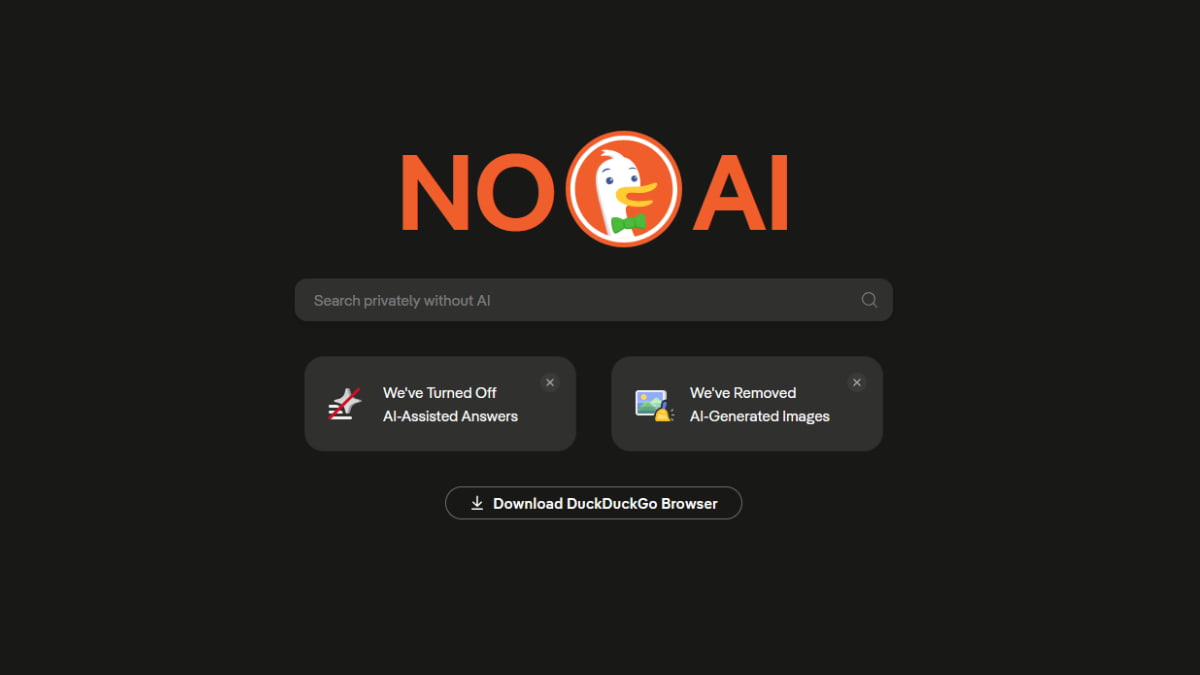
DuckDuckGo’s AI-free search page, noai.duckduckgo.com, averaged 22.7% week over week growth during the same period, peaking at 27.7% on May 24. That page strips every AI feature by default, no AI assisted answers, no AI generated images. The fact that it’s growing faster than general installs suggests users aren’t just downloading DuckDuckGo out of curiosity. They’re specifically looking for the AI-off experience.
What those numbers don’t change is the baseline. DuckDuckGo is growing from 2% of the US search market. A 30% install spike on a small base is meaningful momentum but it’s not a threat to Google’s position this week or next month. The more interesting question is whether these are protest installs that quietly get abandoned when habits reassert themselves, or whether Google’s changes are disruptive enough that some percentage of these users actually stick.
The Memorial Day data point is the one worth watching. DuckDuckGo said it usually sees a traffic dip over the holiday weekend and didn’t this time. If the growth is holding through a period that historically softens it, that’s a signal the shift has some durability behind it.
You May Like: Microsoft and Uber Are Running Into an AI Cost Problem
The irony of DuckDuckGo’s AI product
The opt-out argument is working. What makes it interesting is that DuckDuckGo isn’t actually anti-AI. It has its own AI product called Duck.ai, free, no account required, with access to Claude 4.5 Haiku, Llama 4 Scout, Mistral Small 3, and GPT-5 mini. All chats are private, IP addresses stripped before requests reach model providers, conversations deleted within 30 days, nothing used for training.
It also offers Search Assist, similar to Google’s AI overviews, and an AI Image Filter that removes AI-generated images from results. Both are reportedly among DuckDuckGo’s most popular features despite sitting on opposite ends of the AI preference spectrum.
The difference isn’t that DuckDuckGo is against AI. It’s that everything is optional. You choose how much AI you want. Google made that choice for you. That’s the gap DuckDuckGo is exploiting right now and CEO Gabriel Weinberg knows it. “People just want a choice,” his communications chief said. That’s it. That’s the whole pitch.
Whether any of this sticks
A 30% install spike from a 2% market share base is momentum, not a shift. The real question is how many of these installs survive the first week when muscle memory kicks in and fingers type google.com anyway.
The Memorial Day data suggests at least some durability. Growth held through a weekend that historically softens DuckDuckGo’s numbers.
What Google has done is hand a real argument to every alternative search engine that was struggling to articulate why anyone should switch. Privacy wasn’t enough. Speed wasn’t enough. The forced AI overhaul gave DuckDuckGo something it couldn’t manufacture on its own: a reason that feels personal to ordinary users who just wanted to search for something and got an AI agent instead.
Whether that translates into lasting market share is a different question. But for the first time in a long time DuckDuckGo doesn’t have to explain why it exists. Google did that for them.