


Ideogram was founded by former Google Brain researchers who worked on Imagen, Google’s own text-to-image system. When that team releases an open-weight model, you pay attention.
Ideogram 4 tops the open-weight design leaderboard by a margin that isn’t close. Professional designers picked it first in blind typography tests nearly half the time. At 9.3B parameters it beats open models three times its size on text rendering.
Then we read the license.
Table of Contents
What Ideogram actually built
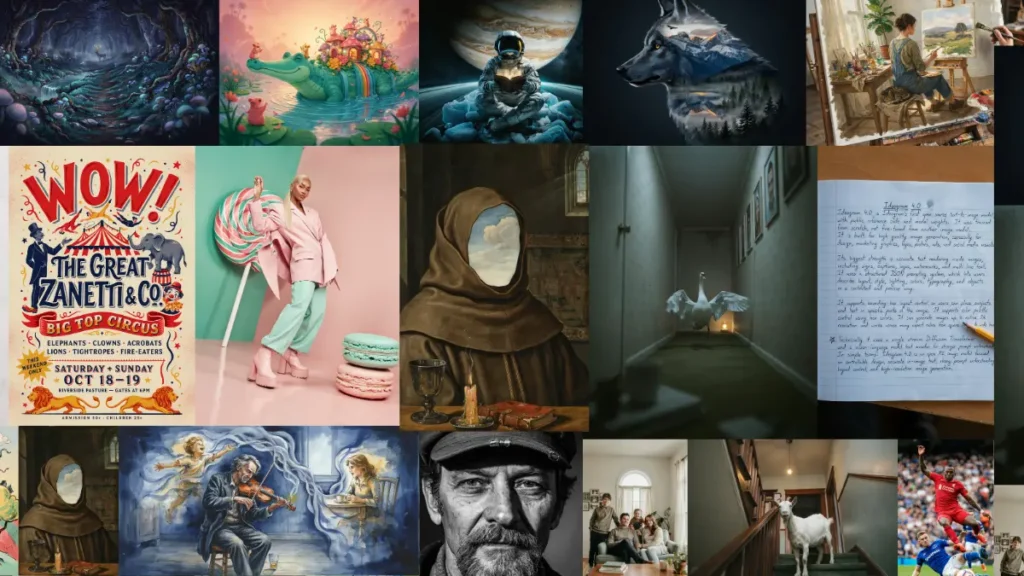
This is not a fine-tune of FLUX or a distillation of anything existing. Ideogram 4 is a 9.3B parameter model trained from scratch on a single-stream Diffusion Transformer architecture. Text and image tokens go into one unified sequence, processed through the same 34-layer transformer.
The text encoder choice is smart. Most image models use CLIP or T5, text-only encoders that were never designed to understand visual concepts deeply. Ideogram 4 uses Qwen3-VL-8B-Instruct, a full vision-language model. Hidden states get extracted from 13 intermediate layers and concatenated, giving the model a much richer understanding of what it’s actually being asked to generate. That’s likely why the typography results look the way they do
Native 2K resolution, flexible aspect ratios from square to 6:1, and JSON-structured prompting round it out. The JSON part is genuinely interesting, the model was trained exclusively on structured captions, so if you want the best results you prompt it with a JSON object describing composition, color palette, layout, and typography explicitly. There’s a magic prompt tool that handles the conversion automatically if you don’t want to write JSON by hand.
Why typography is hard and why this result matters
Text rendering has been the embarrassing weak spot of image generation since the beginning. Stable Diffusion era models would give you something that looked vaguely like letters from a distance and fell apart up close. DALL-E improved it. FLUX improved it further. But legible, accurate, typographically correct text inside a generated image has remained genuinely difficult.
The reason is architectural. Most image models learn from pixels. Text in images is sparse, variable, and context-dependent in ways that pixel-level training struggles with. A model that doesn’t deeply understand language can’t reliably render language, which is why using a vision-language model as the text encoder is a more logical choice than it might first appear.
The ContraLabs evaluation makes the stakes concrete. Ten professional designers from Contra’s top-earning talent judged four models blind across two rounds. Ideogram 4 won 47.9% of first-place picks overall. Gemini 3.1 Flash Image Preview came second at 30%. FLUX.2 max and Grok Imagine split the rest.
The more useful number is the practical one. Asked whether they would use the output in real client work, the same designers rated Ideogram 4 at 3.55 out of 5. Gemini came in at 2.84. That gap between “looks impressive in a demo” and “I’d actually bill a client for this” is where most image models fall apart. Ideogram 4 is one of the few clearing it.
You May Like: Open Source AI Models That Actually Get Text Right in Generated Images
The leaderboard numbers
All figures below come from third-party evaluations unless noted.
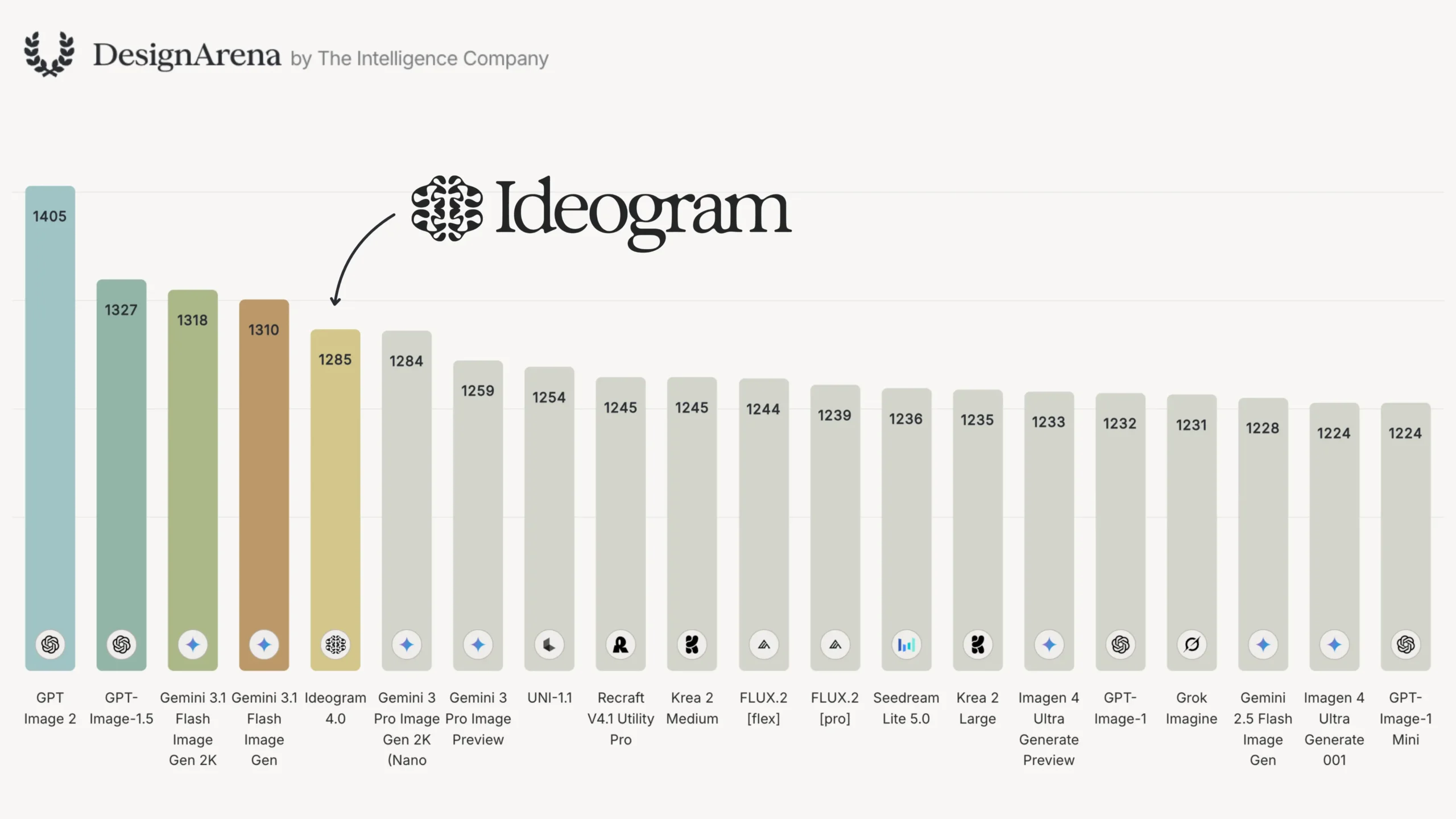
On DesignArena’s overall leaderboard, Ideogram 4 sits at rank 5 with a score of 1285. Everything above it including GPT Image 2, GPT-Image-1.5, two Gemini Flash variants is closed source and costs money per generation. Rank 6 is Gemini 3 Pro Image Gen at 1284. One point.
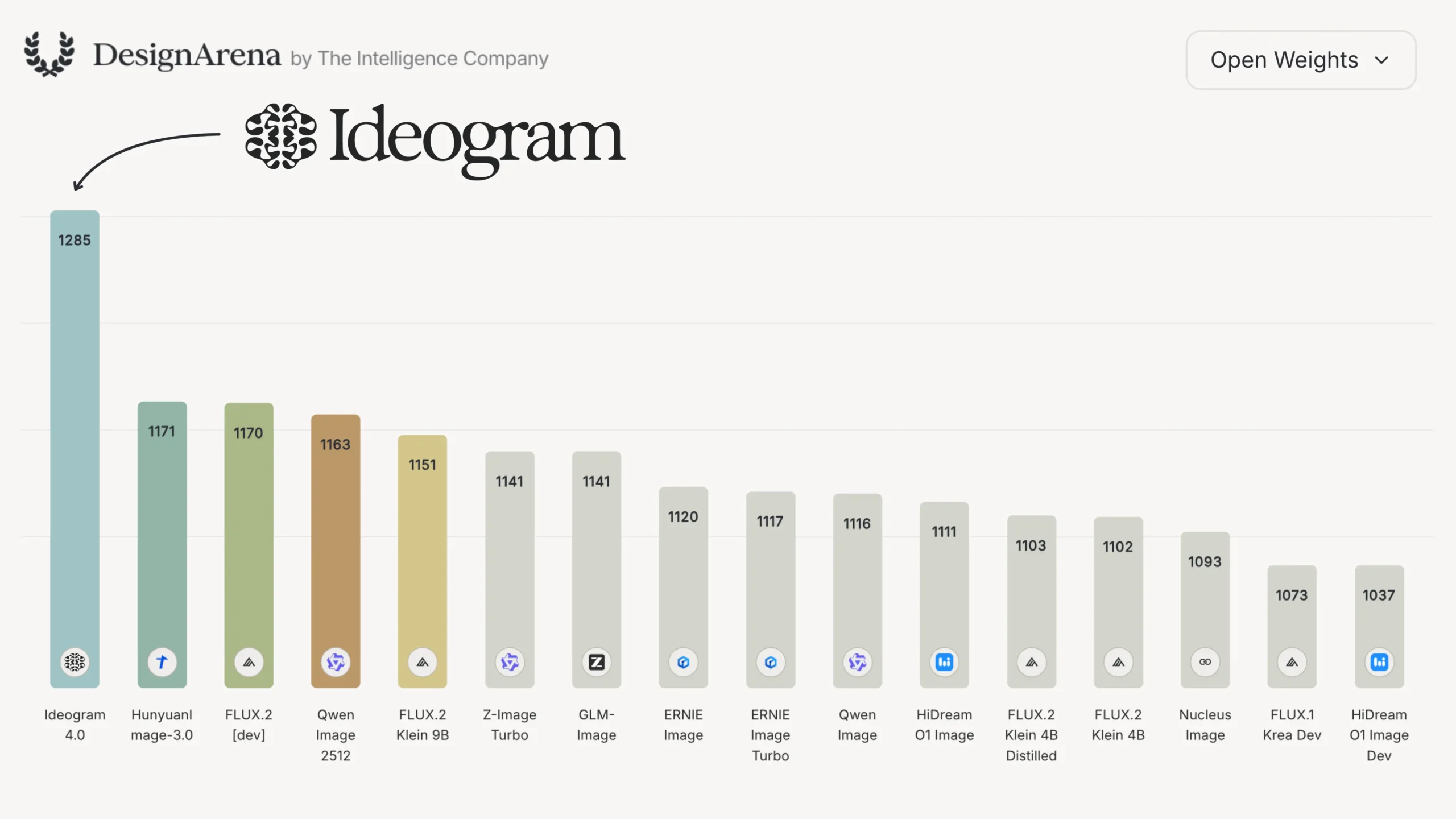
On the open-weight only leaderboard the story is less close. Ideogram 4 scores 1285. Second place HunyuanImage 3.0 scores 1171. That’s a 114-point gap over an 80B MoE model that’s nearly nine times the parameter count. Third place FLUX.2 dev at 1170, fourth place Qwen Image 2512 at 1163. Ideogram 4 leads the open-weight field on design quality by a notable margin.
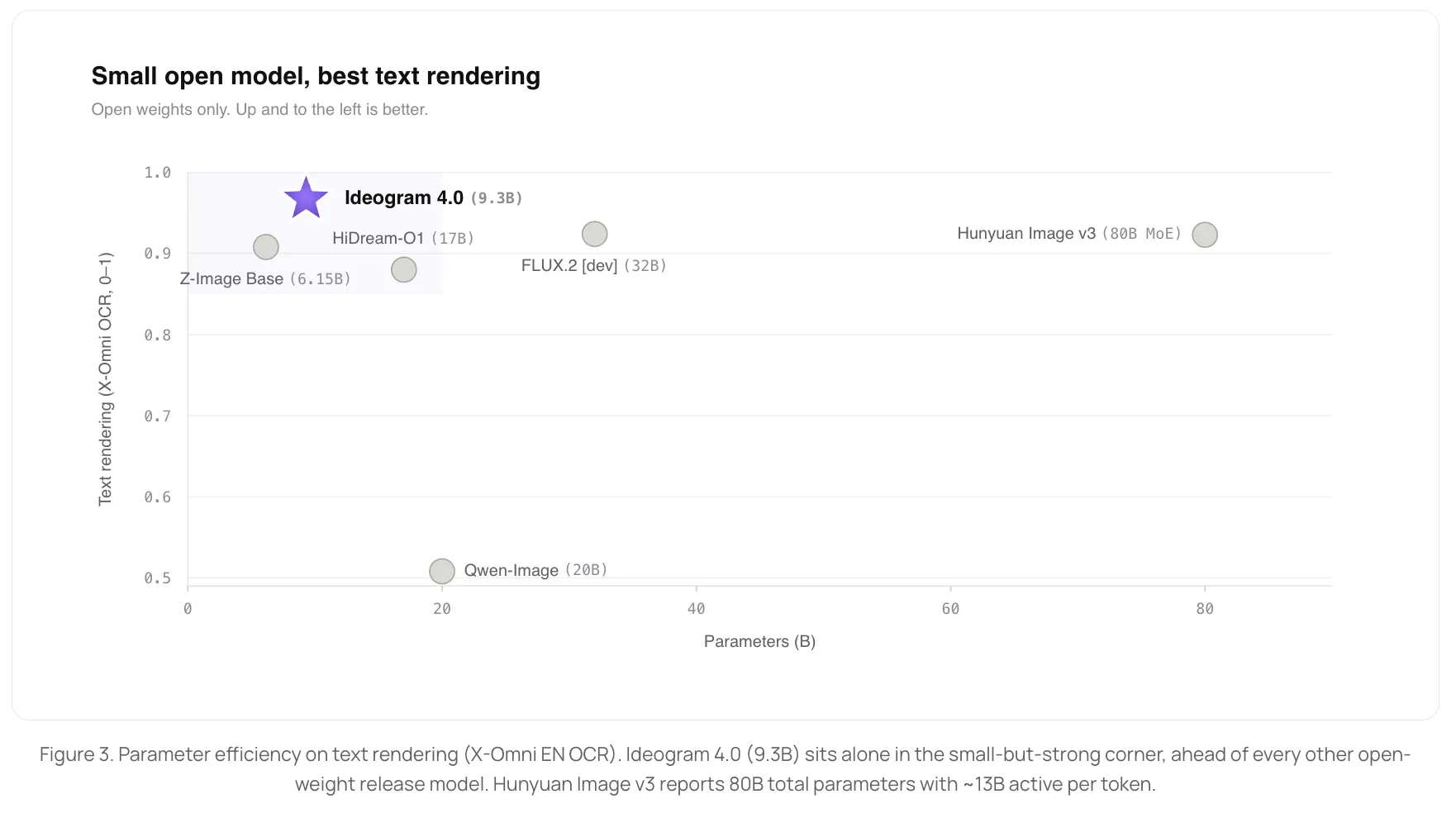
On open-source benchmarks, the parameter efficiency chart is the one worth looking at. On text rendering specifically, Ideogram 4 at 9.3B outperforms Qwen-Image at 20B, FLUX.2 dev at 32B, and HunyuanImage 3.0 at 80B. Smaller model, better text. That’s the Ideogram thesis and the benchmarks are backing it up.
On layout control via 7Bench it beats every closed-source model in the comparison. Its surprising because layout control is where you’d expect the larger proprietary models to have the clearest advantage.
The license
Ideogram 4 ships under the Ideogram Non-Commercial Model Agreement, not Apache 2.0 or MIT. It’s a custom license, and the restrictions matter.
Non-commercial means exactly that. The license permits personal use, research, and evaluation, but commercial use requires a separate agreement with Ideogram. If you’re planning to use the model inside a product, service, or revenue-generating workflow, the public license isn’t designed for that.
That creates an interesting contrast with the benchmark results. In ContraLabs’ evaluation, designers rated Ideogram 4 highest on the question of whether they would use it for real client work, scoring 3.55 out of 5. Yet the model’s public license does not automatically grant the rights needed for most commercial deployments.
There’s another clause worth paying attention to. The agreement prohibits using Ideogram 4 outputs to train, fine-tune, or distill competing models. That’s a broader restriction than many developers associate with open-source AI releases, and it places clear limits on how the model can be incorporated into future AI systems.
None of this makes Ideogram 4 less impressive. It remains one of the strongest open-weight image models available today. But “open-weight” and “open-source” are not the same thing, and Ideogram 4 is a reminder of how large that gap can be.
How to run it
The weights are on Hugging Face under two quantization options — nf4 for CUDA users, fp8 for broader hardware support. Both are gated, meaning you need to accept the license on the model page before the download works. Takes thirty seconds, worth doing before you set up the environment.
The inference repo is on GitHub. Clone it, pip install, and you’re running. For plain text prompts the magic prompt tool handles conversion to the structured JSON format the model was trained on automatically, it calls Ideogram’s hosted API which is free, so you need an API key from developer.ideogram.ai but you’re not paying per call.
For best results set resolution to 2048×2048 and use the V4_QUALITY_48 sampler preset. The model supports any resolution from 256 to 2048 in multiples of 16, so aspect ratio flexibility is real, portrait, landscape, ultrawide banners, all from the same model. It is also available to try on HuggingFace Spaces.
Open weight isn’t the same as open for business
Ideogram 4 is the best open-weight model for design work right now. But “open weight” has been doing a lot of heavy lifting lately as a term, and Ideogram 4 is a good reminder to check what it actually means before you build on something.
If you’re researching, experimenting, or evaluating the model, Ideogram 4 is easy to recommend. If you’re planning to build commercial products or services around it, the license deserves a careful read first.
The model earned the top spot. Just know what you’re agreeing to before you build on it.