



OpenAI says one of its internal reasoning models has solved a math problem that has been there on mathematicians’ desks since 1946.
The problem, first posed by legendary mathematician Paul Erdős, looks almost absurdly simple. Given a set of points on a flat plane, how many pairs can be exactly one unit apart? People have spent nearly 80 years trying to pin down the answer.
OpenAI’s model didn’t just make progress on the problem. According to the company, it disproved a longstanding conjecture that many researchers believed was essentially correct.
Table of Contents
A problem mathematicians thought they understood
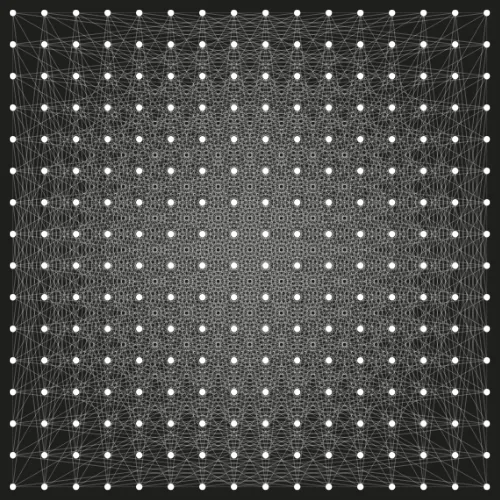
The unit distance problem sounds almost simple. Take a large number of points on a flat plane. How many pairs can sit exactly one unit apart?
Paul Erdős posed the question in 1946. For the next 80 years, nobody could fully solve it.
The strange part is that mathematicians thought they had a pretty good idea of what the answer looked like.
The best-known constructions all revolved around variations of the same idea: arrange points in carefully scaled grid patterns and count how many unit-length connections appear. Researchers improved the math around those constructions, tightened bounds, and explored related versions of the problem.
But the overall picture barely changed. The prevailing belief was that the square-grid approach was probably close to the truth. Maybe not perfect, but close enough that any future improvement would be marginal.
Then OpenAI’s model took a different approach.. Instead of refining the existing approach, it found a construction that breaks away from the grid entirely. The result produces substantially more unit-distance pairs than mathematicians thought possible.
For years, the assumption was that the best-known constructions were already close to optimal. This result suggests there was more room for improvement than researchers realized.
The proof nobody was looking for
According to OpenAI, the proof relies on tools from algebraic number theory, a field concerned with the properties of numbers and abstract algebraic structures. These ideas were never developed to solve questions about points on a plane.
That’s part of why mathematicians found the result surprising.
The solution comes from connecting two areas of mathematics that most people wouldn’t naturally put together.
Several of the researchers who reviewed the proof focused on this point. The result suggests there may be connections between number theory and discrete geometry that mathematicians haven’t fully explored.
You May Like: Best AI Coding Models for Consumer Hardware
Why mathematicians are paying attention
Mathematicians aren’t reacting this way simply because an AI solved an old problem.
Open problems get solved all the time. What caught people’s attention here is the nature of the solution.
The proof appears to contain an idea that experts didn’t expect.
Noga Alon, one of the world’s leading combinatorialists, described the result as an outstanding achievement and said the answer itself was surprising. The prevailing assumption had been that the number of unit distances would stay close to the rate Erdős originally conjectured.
Instead, the new construction shows that assumption was wrong.
Tim Gowers, a Fields Medal winner and one of the mathematicians who reviewed the work, called it a milestone in AI mathematics. Other researchers pointed to the same thing: the proof didn’t just combine existing steps mechanically. It connected ideas from different parts of mathematics in a way that appears genuinely novel.
Most recent AI successes in mathematics have involved solving competition-style problems, checking proofs, or helping researchers explore possibilities. This is one of the first cases where an AI-generated result is being discussed as a meaningful contribution to an active research question.
What changed here?
AI systems have been getting better at mathematics for years. They moved from solving school-level problems to competition problems, then to helping researchers with specific tasks.
This result sits a little further along that path.
The model wasn’t trained specifically for the unit distance problem. It wasn’t built around a custom search system for this proof. According to OpenAI, a general-purpose reasoning model produced the argument.
That’s what makes the reaction from mathematicians notable.
The headline isn’t that a machine solved an 80-year-old problem. Open problems eventually fall. The unusual part is that experts appear to view the proof as containing an idea worth paying attention to.
Whether this turns out to be a one-off result or the beginning of something larger is still unclear. But for the first time, the conversation is about how much of that research it might eventually do on its own.