
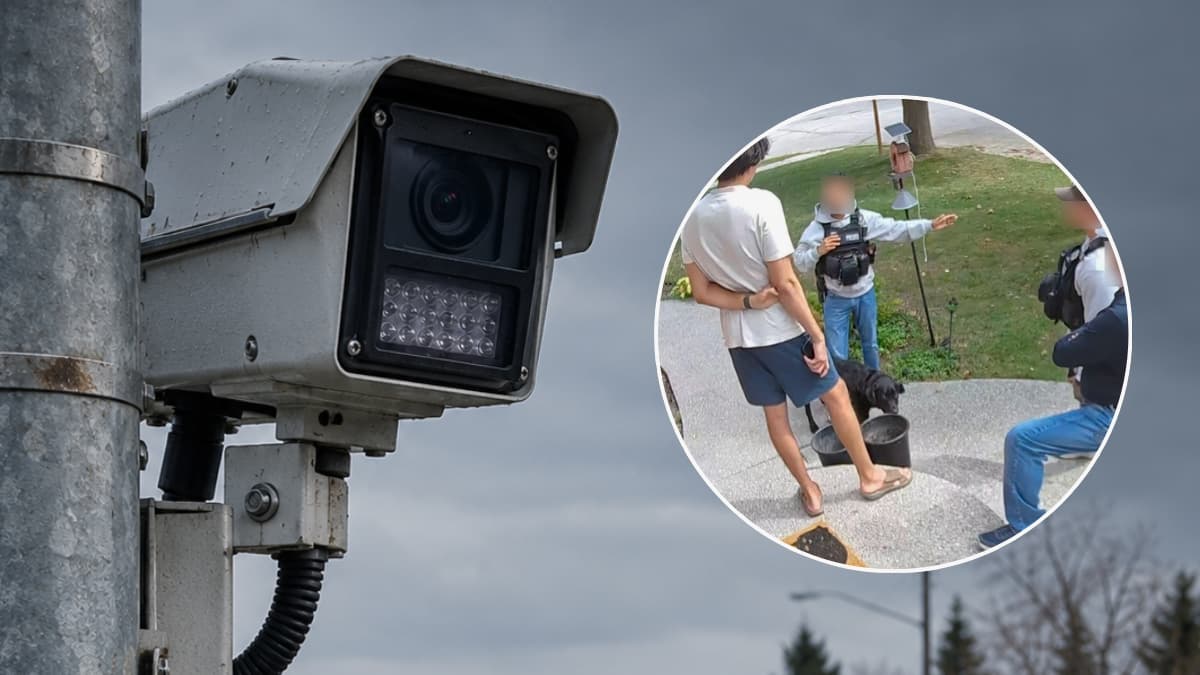

A Canadian developer built a camera that could identify police cars and record their license plates, locations and timestamps.
Then, according to his account, two police officers showed up at his home to ask what he planned to do with the data.
Anthony Sistilli built the system using the same kind of automated license plate recognition technology that has raised privacy concerns around surveillance networks like Flock Safety. His experiment was small, but it raised a big issue: what happens when technology makes it possible to track someone’s movements over time?
The police had concerns about being tracked. Sistilli argued that ordinary people have those same concerns.
Table of Contents
He Built a Miniature Version of a License Plate Surveillance System
Sistilli built his prototype with a roughly $180 camera, a laptop and software he developed with AI coding tools.
The system worked in two stages. First, it tried to identify whether a passing vehicle was a police car. Only then would it attempt to read the license plate. His phone supplied GPS data, allowing the system to save each sighting alongside its time and location and display the records on a map.
The results were modest. During a one-hour test near a police station, he recorded two police vehicles, but struggled to capture their license plates clearly. It was a rough experiment, not a reliable citywide tracking system.
But the basic idea was already there: a camera could turn a passing vehicle into a searchable record of where it had been.
The Privacy Concern Goes Both Ways
According to Sistilli, the officers were concerned that a record of police vehicles could reveal where officers live, when their shifts begin and the routes they regularly take. Information like that, they reportedly explained, could put officers at risk if someone used it to target them.
Sistilli saw a familiar problem. A record of where a vehicle appears, combined with enough observations over time, can reveal patterns its owner never intended to share.
And that concern doesn’t disappear when the vehicle belongs to an ordinary person. A driver might have nothing to hide, yet a searchable record of their movements could still expose where they work, which places they visit regularly or when they’re away from home.
A License Plate Can Become a Record of Your Movements
A single camera seeing your car pass by doesn’t reveal much. The implications change when every sighting is saved with a time and location.
Imagine a car that passes the same camera every weekday morning. One record tells you where it was at a particular moment. Weeks of records could reveal a routine. Add cameras in other locations, and those sightings could help reconstruct more of its movements.
That’s the difference between Sistilli’s small prototype and a connected license plate reader network. Systems such as Flock Safety let authorized users search vehicle sightings across cameras they have permission to access, rather than relying on footage from a single location. Flock describes its system as a searchable investigative tool that stores individual vehicle events for later searches.
The technology doesn’t need to follow a vehicle continuously to build a useful record of where it has appeared. It can piece together separate sightings after the fact.
Also Read: Are AI Chats Private? What the Claude Diary Case Reveals
Who Gets to Search the Data?
The privacy implications depend partly on what happens to the data after a camera captures a vehicle.
Who can search the records? How long are they retained? Can agencies share them with other departments, and are searches logged and reviewed?
Flock says its system records search activity and gives customers control over data sharing and retention, with seven days as the default retention period under its current policy. Those are the company’s stated safeguards; their effectiveness also depends on how individual agencies configure and oversee the system.
These decisions determine not only what a system can collect, but how that information can be used and who is held accountable for its use.
The Question Is Who Gets to Watch Whom
Sistilli’s prototype was limited, and the officers’ visit, as he describes it, was a conversation rather than a reported legal action. But the experiment exposed something worth examining: the same technology can look very different depending on who’s being watched.
A camera, a laptop and a database were enough to demonstrate the basic idea. Building a reliable surveillance network is more complicated, but the underlying capability is no longer confined to large institutions.
The hard questions concern who gets to collect these records, who can search them and what happens when that access is misused.