

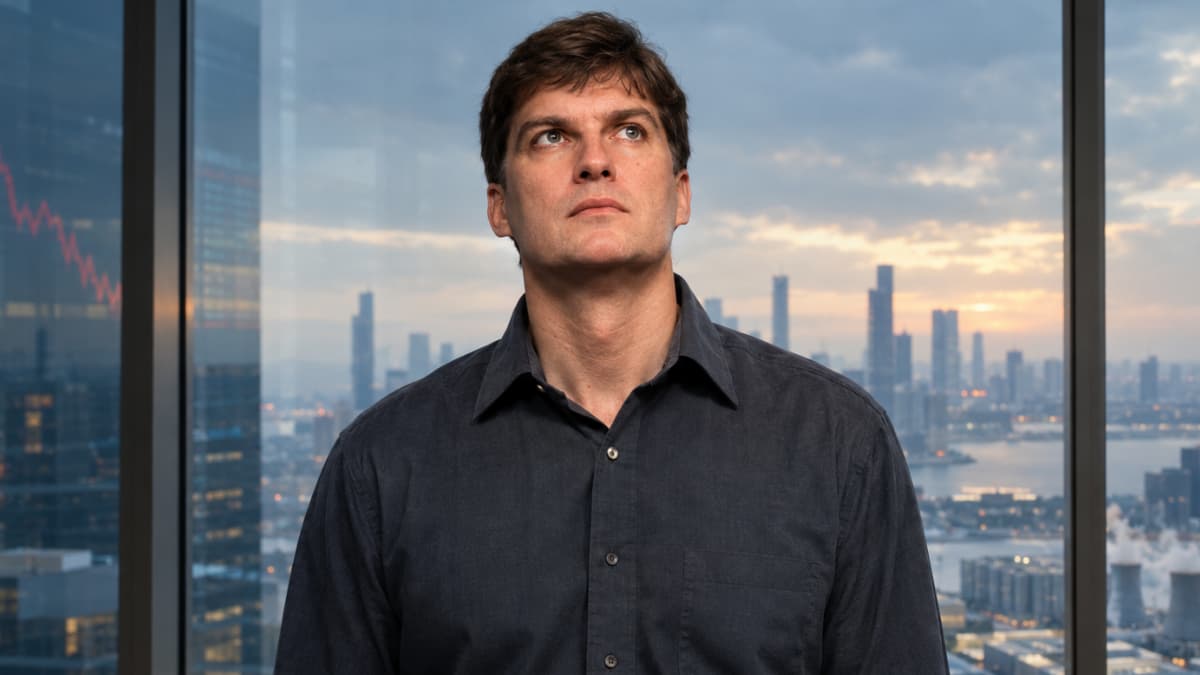

Michael Burry made his name betting against the U.S. housing market before the 2008 financial crisis.
Now he’s betting against something big.
A few days ago, Burry posted on X that, “for the benefit of humanity,” he wants the markets to “tank hard” and prevent OpenAI and Anthropic from going public.
Burry isn’t simply arguing that AI companies are overvalued. He believes the flow of capital into the industry could allow companies like OpenAI and Anthropic to keep expanding their AI operations before the economics of that expansion have been proven.
And an IPO would give them access to even more capital.
That makes Burry’s argument more about what happens when public markets keep financing an industry that requires enormous amounts of money to keep moving forward.
To understand why he wants the market to intervene, you have to look at what that capital is actually paying for.
Table of Contents
Why Burry Wants the Market to Intervene
Burry’s argument starts with capital.
AI companies need enormous amounts of money to keep building larger models and the infrastructure needed to run them. Investors have continued supplying that money because they are betting that the technology will eventually generate businesses large enough to justify the spending.
Burry thinks that cycle can keep going for too long.
He has been critical of the way the AI boom is being financed, including the way major technology companies account for the depreciation of the infrastructure being built for AI. His concern is that the market may be treating today’s spending as an investment in future growth without fully accounting for what happens if the expected returns don’t arrive.
That’s where OpenAI and Anthropic come into his argument.
Both companies are trying to build businesses around increasingly capable AI systems, which requires access to enormous computing resources. Keeping those systems running, expanding capacity and developing new generations of models all require continued investment.
An IPO would give that expansion another source of funding.
That’s why Burry isn’t simply calling for investors to sell AI stocks. He wants the broader market to fall hard enough to make it difficult for companies like OpenAI and Anthropic to raise the money they need through public markets.
In his view, cutting off that source of capital could force the AI industry to confront its spending before it gets even larger.
Whether that logic holds depends on something Burry’s posts don’t settle: how much infrastructure AI companies actually need, how quickly those costs are falling and whether the revenue from all that computing can eventually catch up with the capital being spent on it.
The IPO as a Capital-Raising Mechanism
Private funding can get an AI company too far.
Anthropic, for example, raised $65 billion in its latest private round at a $965 billion valuation. The round included major institutional investors as well as strategic infrastructure partners, giving the company a huge pool of capital to expand its computing capacity and products.
But an IPO changes who can participate in financing that expansion.
Instead of relying primarily on private investors and strategic partners, a public company can raise capital from a much broader pool of investors through the stock market. That doesn’t mean the risk suddenly disappears. It means the company is operating inside a much larger market for capital, with public investors able to buy and sell its shares.
For an AI company with enormous infrastructure requirements, that distinction matters.
Building and running frontier AI systems requires more than the cost of training a model. There are data centers, GPUs, networking, storage, electricity and the ongoing cost of serving customers. As demand grows, the company may need to keep expanding that infrastructure.
So the capital doesn’t necessarily fund one giant training run and then stop.
It can keep feeding the next stage of expansion.
That’s why the IPO is so important to Burry’s argument. He isn’t simply worried about investors losing money after buying AI stocks. His concern is that public markets could provide another large source of funding for companies whose future spending requirements are themselves enormous.
And the scale of those requirements is already becoming visible.
Anthropic’s latest disclosures, for example, show more than $7 billion in 2025 spending on compute and infrastructure and hundreds of billions of dollars in future infrastructure commitments.
That doesn’t prove the spending is excessive. It could also mean the company expects future demand to be large enough to justify building the infrastructure now.
But it changes the question.
The issue isn’t simply whether investors will pay a high valuation for an AI company. It’s whether the capital raised today can eventually produce enough revenue to support the infrastructure that capital is financing.
That’s the economic question underneath Burry’s much louder warning about the IPOs.
The Infrastructure Equation: Unit Costs vs. Total Capital
There is a strange contradiction in the economics of AI right now.
The cost of using AI models is falling rapidly. Epoch AI has found that the cost of achieving a fixed level of performance on some benchmarks has been falling by roughly 47% every quarter. Better models are also becoming cheaper to run as hardware, inference techniques and model architectures improve.
You might expect that to make the AI business easier.
But cheaper intelligence can create a different problem: people use more of it.
When inference becomes cheaper, companies can afford to run models more often, use longer reasoning, build multi-step agents and add AI to workflows that previously would have been too expensive. A system that might once have made one model call can end up making dozens.
So there are two numbers moving in opposite directions:
Cost per unit of intelligence going down
Amount of intelligence being used rises
That makes the total bill much harder to predict.
The same pattern appears at the infrastructure level. Gartner has projected that the total inference cost of agentic workflows could rise more than fivefold through 2028, even as the underlying cost of individual AI operations continues to fall.
This is why looking only at the price of a model can be misleading.
An AI company can make each inference dramatically cheaper while still needing to spend more overall on the hardware, data centers, networking and electricity required to serve a much larger volume of inference.
And that creates the economic question sitting underneath Burry’s argument.
The issue isn’t whether AI will become cheaper. It almost certainly can.
The hard question is whether the economic value created by all that additional AI usage will grow fast enough to justify the capital required to support it.
If businesses become significantly more productive, consumers use AI for tasks they previously couldn’t afford and new applications emerge at scale, today’s infrastructure spending could eventually look necessary.
If usage grows faster than the revenue it generates, the economics become much harder to defend.
That is the equation investors will eventually have to solve.
Also Read: AI Is Getting Cheaper, But AI Bills Could Still Go Up
The Compute Commitments Behind the Headlines
The easiest way to understand Burry’s concern is to look at what OpenAI and Anthropic are actually committing to.
Anthropic’s latest disclosures put billions of dollars of spending into compute and infrastructure, alongside future infrastructure commitments that could eventually reach hundreds of billions of dollars.
That’s not money being spent on a normal software expansion.
It is a bet that the demand for AI computing will become enormous enough to justify building the capacity in advance.
OpenAI is making a similar bet through its own large-scale infrastructure deals and computing commitments.
And there’s a reason these companies are willing to make commitments at this scale. Waiting for demand to arrive before building the infrastructure to serve it doesn’t necessarily work when data centers, chips and power capacity take years to secure.
The problem is that the bet runs in both directions.
If AI usage explodes, these commitments could turn out to be exactly what the companies needed. The infrastructure gets built, customers arrive and the enormous upfront spending becomes the cost of capturing a much larger market.
But if demand doesn’t grow quickly enough, the companies are left paying for infrastructure that isn’t generating enough revenue to justify its cost.
That’s the part that gets lost when the AI debate is reduced to whether models are getting cheaper.
The models can become cheaper while the industry behind them becomes vastly more expensive.
And OpenAI and Anthropic are among the companies making the largest bets that those two things can happen at the same time.
That’s what public investors will eventually have to decide whether they believe.
The Two Futures Facing Public Investors
Burry’s bet ultimately comes down to a question that the AI industry hasn’t answered yet.
Can the economic value created by AI grow fast enough to justify the enormous amount of capital being spent to build it?
If the answer is yes, today’s infrastructure spending could look very different in hindsight. Falling model costs could drive enough additional usage to create entirely new markets, while the companies that built the infrastructure early could end up owning the capacity needed to serve them.
If the answer is no, the same spending starts to look much harder to defend. Cheaper models won’t matter much if the cost of building and operating the systems around them continues to outrun the revenue they generate.
That’s why an OpenAI or Anthropic IPO would be more than another major technology listing.
It would give public investors a direct opportunity to put a valuation on one of the biggest assumptions behind the AI boom: that today’s extraordinary infrastructure spending can eventually produce businesses large enough to justify it.
Burry wants the markets to crash before that test happens.