

Everyone wants their own AI chip.
Google has TPUs. Amazon has Trainium. Meta is building its own accelerators. The goal is to reduce dependence on NVIDIA and have more control over the hardware running their AI workloads.
So you would expect NVIDIA to fight that trend.
Instead, NVIDIA is doing something different.
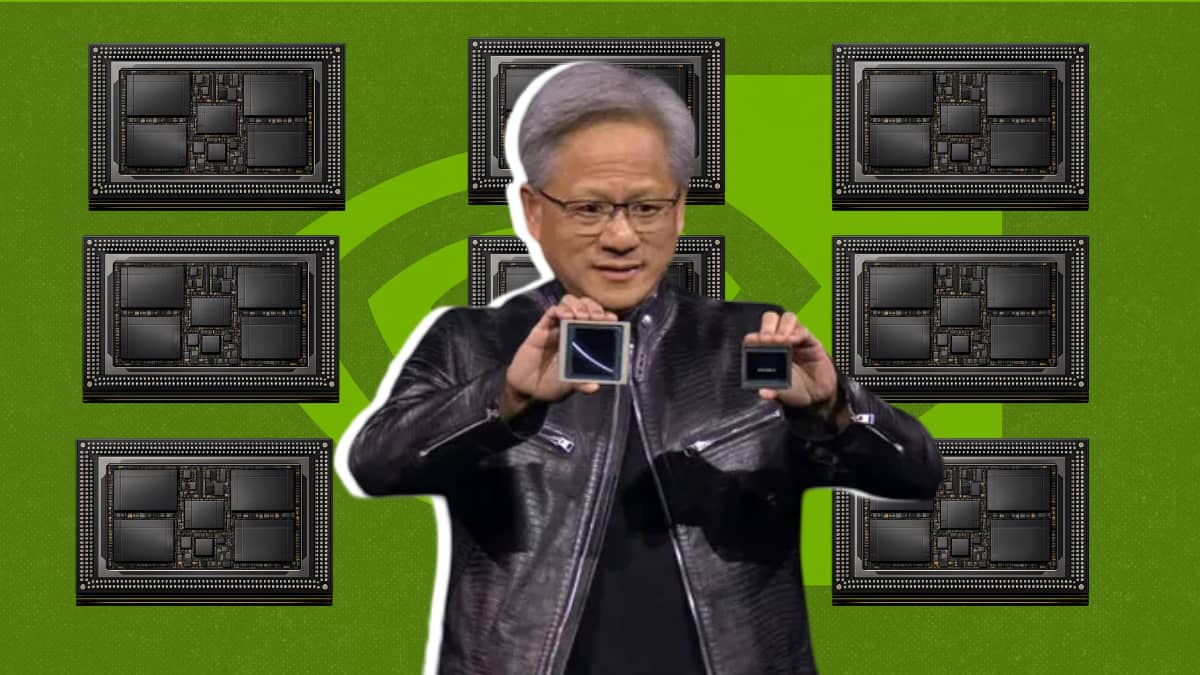
It is making it easier for companies to build custom AI chips that can still connect to NVIDIA’s infrastructure.
So why would NVIDIA help its own customers build chips that could compete with its GPUs?
Table of Contents
Fine. Build your own chip.
NVIDIA is investing $3.5 billion in convertible bonds issued by MediaTek.
At the same time, MediaTek is adopting NVIDIA’s NVLink Fusion platform to help customers build custom AI accelerators that can connect to NVIDIA’s rack-scale AI systems.
That is basically what NVIDIA is offering with NVLink Fusion.
MediaTek can build the custom chips, while NVIDIA provides the pieces needed to connect them to its AI infrastructure.
That includes the NVLink connection itself, memory technology, chip-to-chip connectivity and the system infrastructure around it.
For a company building its own accelerator, that removes a lot of the work that comes after designing the chip.
So a company can build its own silicon without having to walk away from the infrastructure it may already be using.
And that changes the choice companies have to make.
They don’t necessarily have to choose between their own chip and NVIDIA’s ecosystem. They can have both.
But why NVIDIA?
This is where NVIDIA has a problem.
A company building its own AI chip does not have to use NVLink. It can build around Ethernet. It can work with Broadcom. It can also look at UALink, which was created as a vendor-neutral alternative for connecting AI accelerators.
So NVIDIA cannot win this simply by saying, “We’ll connect your chip for you.”
The appeal is the amount of work that comes with the connection.
Building a custom accelerator is only one part of building an AI system. Companies also have to deal with how those chips communicate, how memory is connected, how the systems are packaged and how everything works together inside a large AI cluster.
NVIDIA already has much of that infrastructure in place.
That gives companies a choice between building more of the stack themselves or using an existing NVIDIA architecture and putting their own silicon into it.
For a company that wants control over its chip without taking on the engineering burden of building an entirely separate AI infrastructure, that tradeoff could be worth it.
NVIDIA’s moat may no longer be the chip
This strategy becomes more important if custom AI chips actually take off.
NVIDIA doesn’t necessarily need every company to buy its GPU if those companies still need NVIDIA’s infrastructure to build and run their AI systems.
That changes what competition looks like.
A company can replace the accelerator without replacing everything around it. NVIDIA can still be part of the system through the interconnect, networking and rack-scale architecture.
So the fight is no longer only about whose chip wins.
It is also about which infrastructure companies choose to build around those chips.
And NVIDIA already has a huge head start there.
Also Read: You Talk to ChatGPT Like a Therapist. A Court May Treat the Conversation Like Evidence.
But NVIDIA is not the only one in this game
NVIDIA’s approach is only one option.
Companies can build around Ethernet and Broadcom, or use UALink if they want a more vendor-neutral way to connect their accelerators.
That leads to a different setup.
The idea behind UALink is that companies should be able to mix accelerators and infrastructure without having one company own the entire connection layer. Broadcom’s Ethernet technology takes a similar approach by giving companies the building blocks to design their own AI networking systems.
NVIDIA is offering a different tradeoff.
Instead of assembling the pieces themselves, companies can use an architecture NVIDIA has already built and validated around its own infrastructure.
One approach gives companies more freedom to mix and match. The other can reduce the amount of engineering required to make the whole system work.
Neither choice is free.
With the open approach, companies get more control but may take on more integration work. With NVIDIA, they get a more tightly connected platform, but they also become more dependent on NVIDIA’s technology.
And that is the trade NVIDIA is asking companies to make.
And then there is Hugging Face
NVIDIA’s reported $12.9 billion acquisition of Hugging Face would take this strategy beyond chips and infrastructure.
Hugging Face is where developers find, share and work with open AI models, datasets and tools. In other words, it sits much closer to the people actually building with AI.
With NVLink Fusion, NVIDIA can stay part of the system even when a company builds its own accelerator.
NVIDIA would not need to make every model or every chip itself. It could be present in more of the stack that connects the two.
And if the AI industry keeps becoming more fragmented, with companies using different chips, models and infrastructure, being the layer that developers and systems keep coming back to could become just as valuable as selling the fastest GPU.
The Hugging Face deal is still a reported transaction rather than something we should treat as a completed acquisition. But the direction is hard to ignore: NVIDIA is expanding its reach beyond the accelerator itself.
You can leave the GPU. Can you leave NVIDIA?
The AI chip race is becoming less about who can build the fastest accelerator and more about who can remain essential when the hardware starts to change.
Custom chips are not going away, and NVIDIA doesn’t necessarily have to stop them. If those chips can still plug into NVIDIA’s infrastructure, the company can remain deeply embedded in the AI systems being built around them.
That may be the smarter way to defend its position.
Because replacing a GPU is one thing. Replacing the infrastructure, software and ecosystem built around it is a big decision.