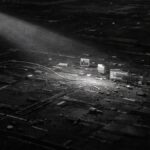


Last year, a UPS cargo plane went down in Louisville, Kentucky. The crew didn’t survive. The NTSB opened an investigation, as it does with every major crash, and added the case files to its public docket system, as it also does. Transcripts, data, findings, all of it accessible to anyone who wanted to look.
What nobody thought about was the spectrogram.
A spectrogram is a visual representation of sound. It takes audio signals, breaks them down into frequencies, and renders them as an image. The NTSB included one in the Flight 2976 docket because federal law prohibits it from releasing actual cockpit voice recordings. The spectrogram felt like a reasonable middle ground, you could see that audio existed without being able to hear it.
Then Scott Manley, a YouTuber with a background in physics, pointed out on X that spectrograms encode enough data to work backwards from. The image wasn’t just a picture of sound. It contained the sound.
People ran with it. Using AI tools, they took the spectrogram and the publicly available transcript and reconstructed approximations of what the cockpit voice recorder actually captured. The voices of two pilots who died in that crash started circulating online.
The NTSB shut its entire public docket system down.
The gap nobody thought to close
What makes this situation unsettling is that nobody appears to have hacked or leaked anything.
The docket was public because NTSB investigations are supposed to be transparent. The spectrogram was included because it technically was not an audio recording. The transcript was already public. And the AI tools used to stitch everything together are the same kinds of tools millions of people use every day.
Nobody broke into a system or stole cockpit audio from a server. People simply realized that the boundary between image and audio no longer means much once modern AI tools enter the picture.
The NTSB’s response and what it reveals
The agency’s move was immediate. Shut the whole docket system down. Then restore it, but keep 42 investigations closed pending review, including Flight 2976.
That response is telling. The NTSB didn’t have a surgical fix ready because there wasn’t one. You can’t un-include a spectrogram from a filing that’s already been public. You can’t retroactively make the transcript harder to find. The only lever available was access, so they pulled it.
What that means practically is that researchers, journalists, aviation safety advocates, and family members of crash victims lost access to investigation data they had every right to see. A transparency system built around openness suddenly collided with tools that changed what public data can mean.
And this probably will not be the last time something like this happens.
A lot of institutional rules were written for a world where formats stayed in their lanes. Images were images. Audio was audio. Text was text. AI systems increasingly blur those boundaries, and organizations are finding out in real time that policies built around older assumptions do not always hold up anymore.
You May Like: Anthropic’s Mythos Just Helped Find macOS vulnerability That Could Break Apple’s Security Protections
Who’s responsible when nobody meant for this to happen?
The person who pointed out the spectrogram could be reconstructed wasn’t trying to harm anyone. The people who ran the reconstruction were curious, or technically showing off, or both. The NTSB published the spectrogram in good faith under rules that made sense when they were written. The AI tools involved are general purpose and widely used.
There’s no villain here. There’s just a collision between old policy and new capability, and two people who didn’t survive a crash whose voices approximations ended up on the internet without anyone’s permission,
That is what makes this situation harder to process. There is no obvious breach point where everything clearly went wrong. Just a chain of reasonable decisions that ended somewhere nobody expected.
And yet two pilots who died in a crash had of their voices circulating online without their families ever consenting to it.
Grief doesn’t care about intent. The federal rule banning the release of cockpit recordings existed for a reason. The problem is that the policy assumed a spectrogram and an audio file were different things. AI tools made that distinction a lot weaker than regulators realized.
Someone will close it now. But it took this to make that obvious.
Someone will probably rewrite those rules now. But stories like this keep revealing the same pattern: technology moves first, and institutions only discover the gaps after something uncomfortable slips through them.