


Most text-to-speech AI fall into two camps. The ones that sound good need serious hardware. The ones that run on anything sound robotic. MOSS-TTS-Nano is trying to be neither.
It’s a 100 million parameter model that runs on a regular CPU and it actually sounds good. Good enough that the team behind it built an entire family of speech models around the same core technology, one of which has gone head to head with Gemini 2.5 Pro and ElevenLabs and come out ahead on speaker similarity.
It just dropped on April 13th and it’s the newest addition to the MOSS-TTS family, a collection of five open source speech models from MOSI.AI and the OpenMOSS team. The family doesn’t just cover lightweight local deployment. One of its models MOSS-TTSD outperforms Gemini 2.5 Pro and ElevenLabs on speaker similarity in benchmarks. Another generates voices purely from text descriptions with no reference audio needed. And one is built specifically for real-time voice agents with a 180ms first-byte latency.
Nano is the entry point. The family is the story.
Table of Contents
Meet the Family
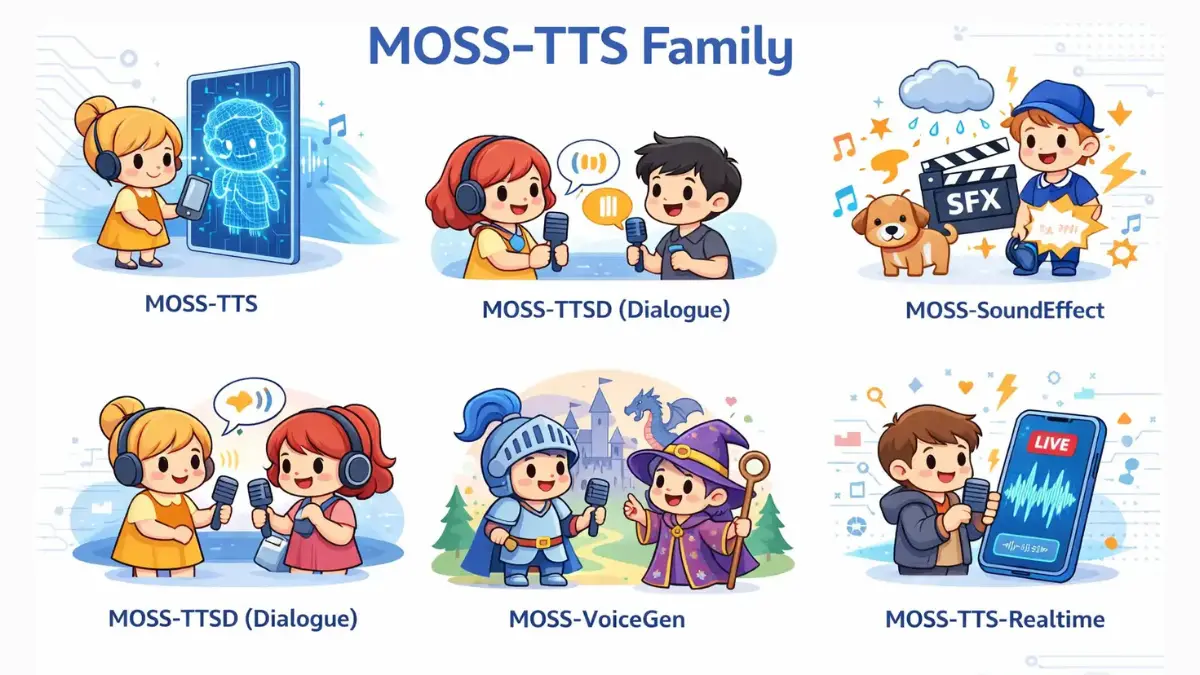
The MOSS-TTS family isn’t five versions of the same thing. Each model was built for a different problem and they’re genuinely distinct from each other.
MOSS-TTS is the flagship. It’s the one you reach for when you need the best voice quality zero-shot voice cloning, long-form speech that stays stable across minutes, fine-grained control over pronunciation. It comes in two sizes, 8B and 1.7B, and it’s what most benchmarks in this family are measured against.
MOSS-TTSD is the dialogue model. Two speakers, back and forth, with natural pacing and expressiveness that makes it sound like an actual conversation. This is the one that beat Gemini 2.5 Pro and ElevenLabs. More on that later.
MOSS-VoiceGenerator does something none of the others do. You describe a voice in plain text like age, tone, accent, character and it creates one from scratch. No reference audio needed. You’re designing a voice the way you’d describe a character.
MOSS-TTS-Realtime is built for voice agents. The kind that need to respond in under half a second and stay coherent across a full conversation. It hits 180ms time-to-first-byte after warmup which in voice agent terms is genuinely fast.
MOSS-SoundEffect is the odd one out in the best way. It generates environmental audio like rain, traffic, crowd noise, mechanical sounds from text descriptions with controllable duration. Useful for anyone building games, videos, or interactive experiences who doesn’t want to dig through royalty-free sound libraries.
Five models, one shared audio backbone, all Apache 2.0. You can use any of them independently or chain them together depending on what you’re building.
MOSS-TTS-Nano: The One That Changes the Access Problem
The access problem in local TTS has always been the same, the models worth using require hardware most people don’t have. An 8B model sounds great but it needs a GPU with enough VRAM to load it. That immediately rules out a huge chunk of people who’d otherwise use it.
Nano sidesteps this completely. At 100M parameters it’s small enough to run on 4 CPU cores and still stream audio in real time. That means a developer building a local app doesn’t need to spec their users’ machines around a GPU requirement. A researcher testing something doesn’t need to spin up cloud compute. Someone who just wants local voice AI on a modest laptop can actually have it.
The audio quality is 48kHz stereo, higher than most TTS models output by default. It supports 20 languages including Chinese, English, Arabic, Japanese, Korean and more. Voice cloning works with a reference audio file and handles long text automatically by chunking it without you having to manage that yourself.
Setup is straightforward. Clone the repo, install requirements, point it at a reference audio file and give it text. There’s a CLI, a local web demo via FastAPI, and a Python API if you want to integrate it into something.
Running Light, Building Fast
The 8B flagship model fits on an 8GB GPU and if you don’t have one, there’s a fully torch-free path using llama.cpp for the backbone and ONNX Runtime for the audio tokenizer. No PyTorch installation required at all.
The llama.cpp path has four ready-made configs depending on your setup. Default ONNX, TensorRT for maximum throughput, a low-memory mode specifically tuned for 8GB GPUs, and a fully CPU-only option with no GPU involved whatsoever. You pick the one that matches your machine and go from there.
The community hasn’t been waiting around either. There’s already a ComfyUI extension for anyone who lives in that workflow. An OpenAI-compatible TTS API wrapper so you can drop MOSS-TTS into anything that already speaks to OpenAI’s audio endpoints. AnyPod, a podcast generation tool that uses MOSS-TTS and MOSS-TTSD as its backend. And a Norwegian LoRA adapter fine-tuned on the NST Norwegian speech dataset, contributed by a developer at Tosee, which tells you something about how quickly people are taking this and running with it.
A model that ships with this many entry points and already has community tooling two months in is worth paying attention to.
The Number Worth Knowing
Benchmarks in AI are easy to dismiss. Every model release comes with numbers that somehow make it look better than everything else. So when I say MOSS-TTSD-v1.0 beat Gemini 2.5 Pro on speaker similarity, I want to be specific about what that actually means.
On English speaker similarity, MOSS-TTSD scored 0.7893. Gemini 2.5 Pro scored 0.6786. That’s a open source dialogue model outperforming one of Google’s best on the metric that matters most for multi-speaker audio – does it actually sound like the right person is talking.
ElevenLabs V3 came in at 0.6730 on the same test. MOSS-TTSD beat that too.
For Chinese, it scored 0.7949 on speaker similarity against Doubao Podcast’s 0.8034, close enough that the gap is essentially a coin flip in practice.
These are the team’s own evaluations so treat them as self-reported. But the methodology is documented, the benchmark is public, and the numbers are specific enough to be meaningful.
| Model | EN SIM | ZH SIM |
|---|---|---|
| MOSS-TTSD-v1.0 | 0.7893 | 0.7949 |
| Gemini 2.5 Pro | 0.6786 | — |
| ElevenLabs V3 | 0.6730 | 0.6970 |
| Doubao Podcast | — | 0.8034 |
Related: Open-Source TTS Models That Can Clone Voices and Actually Sound Human
Which One Is Right for You
That depends on what you’re actually trying to do. Just want to try local voice AI today without worrying about your hardware? Start with Nano. It runs on whatever you have, setup takes minutes, and the demo is live on Hugging Face right now if you want to hear it before installing anything.
Building something that needs the best voice quality and you have a GPU to work with? The 8B MOSS-TTS flagship is the one. GGUF weights are ready, llama.cpp path works, and an 8GB GPU is enough with the low memory config.
If you need two voices having a natural conversation. MOSS-TTSD is what you want and the benchmark numbers suggest it’s the strongest open source option in that specific space right now.
Want to create a completely new voice from a text description without any reference audio at all? MOSS-VoiceGenerator does exactly that and nothing else in this family does it.
For a live voice agent that needs to respond fast and stay consistent across a full conversation? MOSS-TTS-Realtime was designed for that problem specifically.
All five models are on Hugging Face and ModelScope. The main repo is on GitHub under OpenMOSS. The whole family is Apache 2.0, build, fine-tune & use commercially. A family this complete, this accessible, and this honest about what each model is for doesn’t come around often. Worth bookmarking even if you don’t need it today.